identifying marginal and joint frequencies\nan electronics company polled 300 random people to find out…
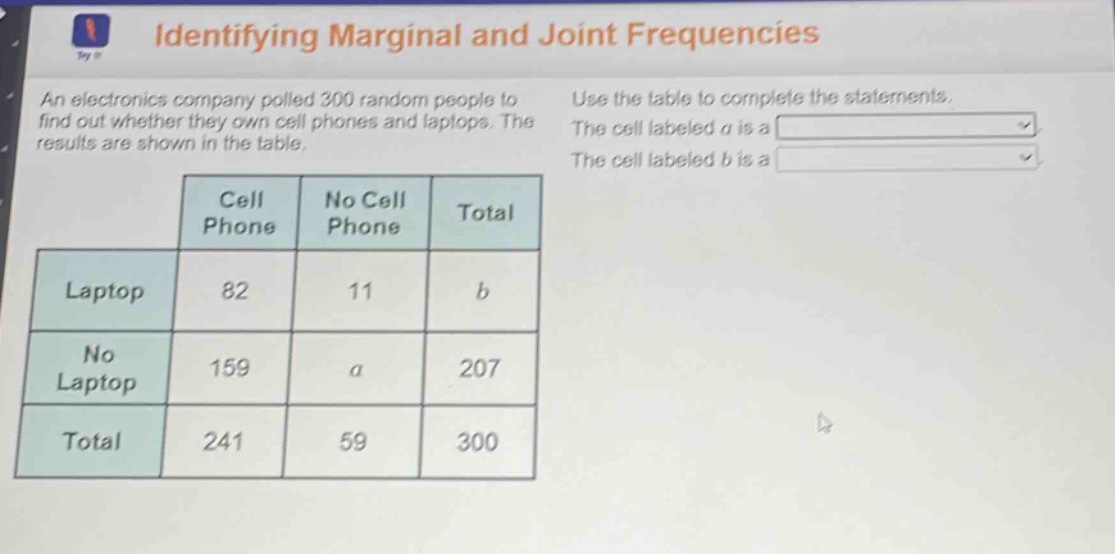
identifying marginal and joint frequencies\nan electronics company polled 300 random people to find out whether they own cell phones and laptops. the results are shown in the table.\nuse the table to complete the statements.\nthe cell labeled a is a \nthe cell labeled b is a \n| | cell phone | no cell phone | total |\n|--|--|--|--|\n| laptop | 82 | 11 | b |\n| no laptop | 159 | a | 207 |\n| total | 241 | 59 | 300 |
Answer
Answer:
The cell labeled a is a joint frequency. The cell labeled b is a marginal frequency.
Brief Explanations:
A joint frequency shows the frequency of data that belongs to two - categories simultaneously. Cell a represents the number of people who have no cell phone and no laptop, so it's a joint frequency. A marginal frequency is the total of a row or a column in a two - way table. Cell b is the total number of people who own a laptop, so it's a marginal frequency.