information about the recycling drive at school is shown in the table. let a be the event that the item…
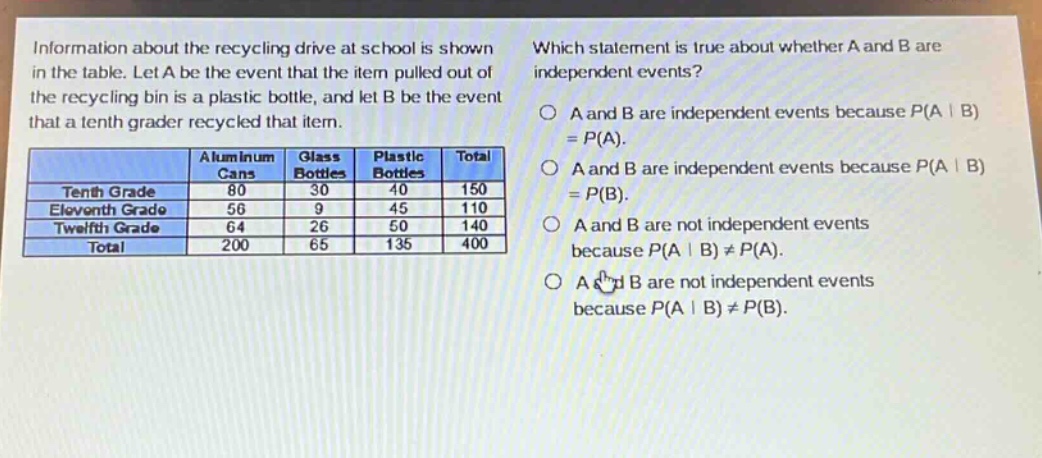
information about the recycling drive at school is shown in the table. let a be the event that the item pulled out of the recycling bin is a plastic bottle, and let b be the event that a tenth - grader recycled that item. which statement is true about whether a and b are independent events? a and b are independent events because p(a | b)=p(a). a and b are independent events because p(a | b)=p(b). a and b are not independent events because p(a | b)≠p(a). a and b are not independent events because p(a | b)≠p(b).\n| | aluminum cans | glass bottles | plastic bottles | total |\n|--|--|--|--|--|\n| tenth grade | 80 | 30 | 40 | 150 |\n| eleventh grade | 56 | 9 | 45 | 110 |\n| twelfth grade | 64 | 26 | 50 | 140 |\n| total | 200 | 65 | 135 | 400 |
Answer
Explanation:
Step1: Calculate P(A)
The total number of items is 400. The number of plastic bottles is 135. So $P(A)=\frac{135}{400}=\frac{27}{80}$.
Step2: Calculate P(A|B)
The number of items recycled by tenth - graders is 150, and the number of plastic bottles recycled by tenth - graders is 40. So $P(A|B)=\frac{40}{150}=\frac{4}{15}$.
Step3: Compare P(A) and P(A|B)
Since $\frac{27}{80}\neq\frac{4}{15}$, that is $P(A|B)\neq P(A)$.
Answer:
A and B are not independent events because $P(A|B)\neq P(A)$.