an insurance company selected samples of clients under 18 years of age and over 18 and recorded the number…
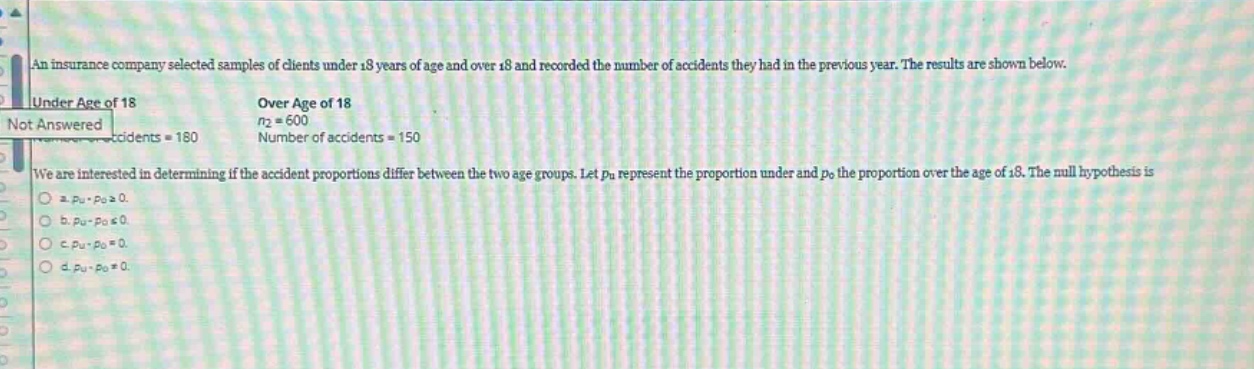
an insurance company selected samples of clients under 18 years of age and over 18 and recorded the number of accidents they had in the previous year. the results are shown below. under age of 18 over age of 18 n1 = 600 n2 = 600 number of accidents = 180 number of accidents = 150 we are interested in determining if the accident proportions differ between the two age groups. let p1 represent the proportion under and p2 the proportion over the age of 18. the null hypothesis is a. p1 - p2 >= 0. b. p1 - p2 < 0. c. p1 - p2 = 0. d. p1 - p2 != 0.
Answer
Explanation:
Step1: Define null hypothesis concept
The null hypothesis ($H_0$) for testing the difference between two - population proportions assumes no difference.
Step2: Express null hypothesis for proportions
If $p_u$ is the proportion of accidents for under - 18s and $p_o$ is the proportion of accidents for over - 18s, the null hypothesis is $p_u - p_o=0$.
Answer:
C. $p_u - p_o = 0$