interpolating data\nheather is training for a long - distance run. her data points listed below represent…
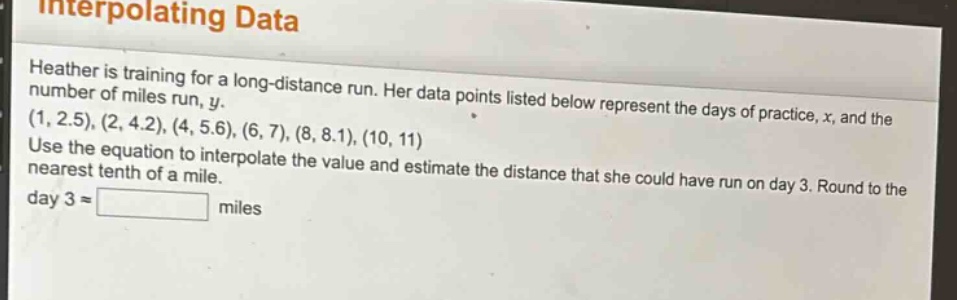
interpolating data\nheather is training for a long - distance run. her data points listed below represent the days of practice, x, and the number of miles run, y.\n(1, 2.5), (2, 4.2), (4, 5.6), (6, 7), (8, 8.1), (10, 11)\nuse the equation to interpolate the value and estimate the distance that she could have run on day 3. round to the nearest tenth of a mile.\nday 3 ≈ miles
Answer
Explanation:
Step1: Assume a linear - interpolation
We have two data - points closest to (x = 3), which are ((2,4.2)) and ((4,5.6)). The linear interpolation formula between two points ((x_1,y_1)) and ((x_2,y_2)) for a value (x) is (y=y_1+\frac{y_2 - y_1}{x_2 - x_1}(x - x_1)). Here (x_1 = 2), (y_1=4.2), (x_2 = 4), (y_2 = 5.6), and (x = 3).
Step2: Calculate the slope
First, calculate the slope (m=\frac{y_2 - y_1}{x_2 - x_1}=\frac{5.6 - 4.2}{4 - 2}=\frac{1.4}{2}=0.7).
Step3: Calculate the interpolated value
Then, use the formula (y=y_1+m(x - x_1)). Substitute (x_1 = 2), (y_1 = 4.2), (m = 0.7), and (x = 3) into the formula: (y=4.2+0.7\times(3 - 2)=4.2 + 0.7=4.9).
Answer:
4.9