interpreting the magnitude of residuals\npoints and their residual values are shown in the table. which…
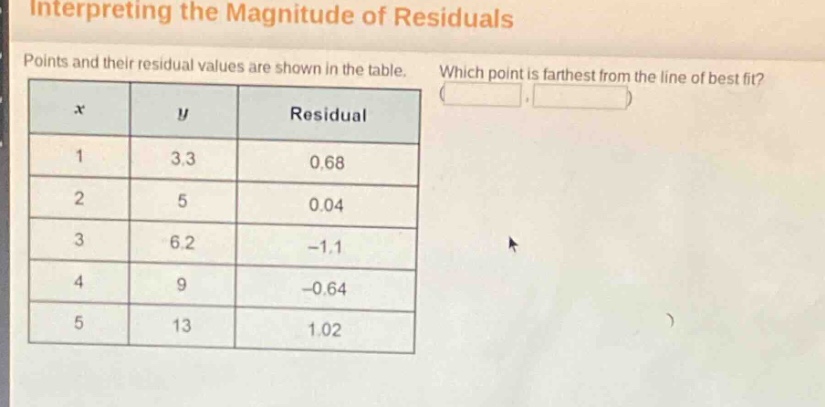
interpreting the magnitude of residuals\npoints and their residual values are shown in the table. which point is farthest from the line of best fit?\n| x | y | residual |\n|----|----|----|\n| 1 | 3.3 | 0.68 |\n| 2 | 5 | 0.04 |\n| 3 | 6.2 | -1.1 |\n| 4 | 9 | -0.64 |\n| 5 | 13 | 1.02 |
Answer
Answer:
$(3, 6.2)$
Explanation:
Step1: Recall residual concept
The residual is the vertical distance from a data - point to the line of best fit. The larger the absolute value of the residual, the farther the point is from the line of best fit.
Step2: Calculate absolute values of residuals
For the first point: $|0.68| = 0.68$; for the second point: $|0.04| = 0.04$; for the third point: $|-1.1| = 1.1$; for the fourth point: $|-0.64| = 0.64$; for the fifth point: $|1.02| = 1.02$.
Step3: Compare absolute values
Since $1.1>1.02 > 0.68>0.64 > 0.04$, the point with $x = 3$ and $y = 6.2$ (which has a residual of - 1.1) has the largest absolute - value of the residual. So the point $(3,6.2)$ is farthest from the line of best fit.