the interquartile range of the data set is 4.\n2, 2, 3, 3, 4, 5, 5, 6, 7, 9, 12\nwhich explains whether or…
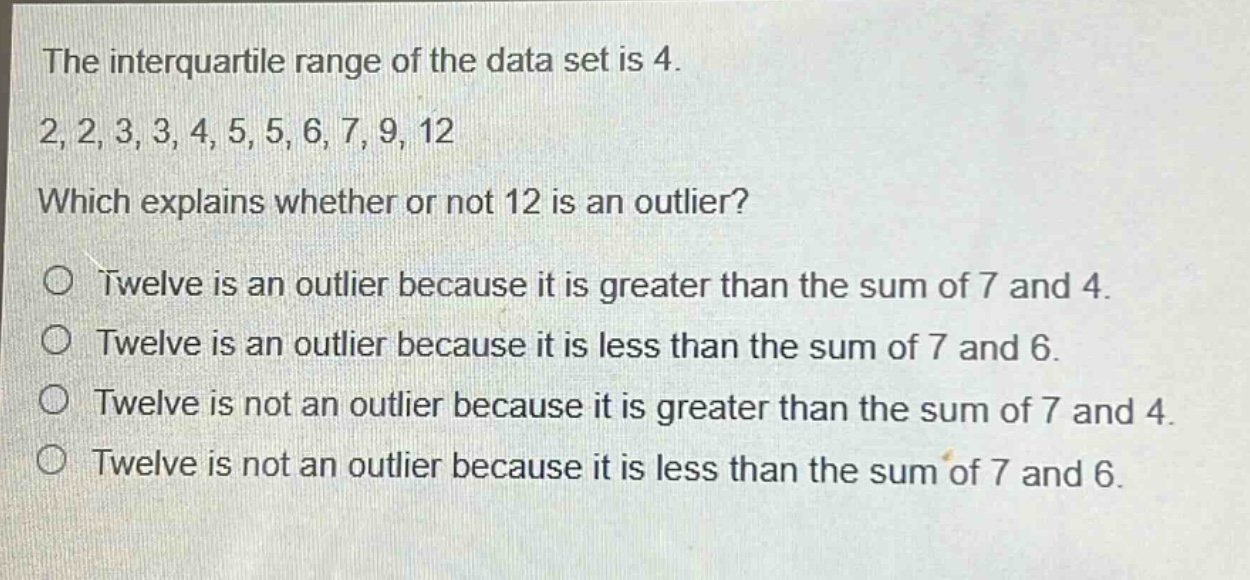
the interquartile range of the data set is 4.\n2, 2, 3, 3, 4, 5, 5, 6, 7, 9, 12\nwhich explains whether or not 12 is an outlier?\no twelve is an outlier because it is greater than the sum of 7 and 4.\no twelve is an outlier because it is less than the sum of 7 and 6.\no twelve is not an outlier because it is greater than the sum of 7 and 4.\no twelve is not an outlier because it is less than the sum of 7 and 6.
Answer
Explanation:
Step1: Recall out - lier rule
To check if a value is an outlier, we use the rule: Upper outlier boundary = $Q_3+ 1.5\times IQR$, where $Q_3$ is the third - quartile and $IQR$ is the inter - quartile range. Here, $IQR = 4$ and assume $Q_3=7$ (since we are checking the upper value).
Step2: Calculate upper outlier boundary
The upper outlier boundary is $Q_3 + 1.5\times IQR=7+1.5\times4=7 + 6=13$.
Step3: Compare the value with boundary
The value 12 is less than 13. So 12 is not an outlier.
Answer:
Twelve is not an outlier because it is less than the sum of 7 and 6.