the interquartile range of the data set is 4. 2, 2, 3, 3, 4, 5, 5, 6, 7, 9, 12 which explains whether or not…
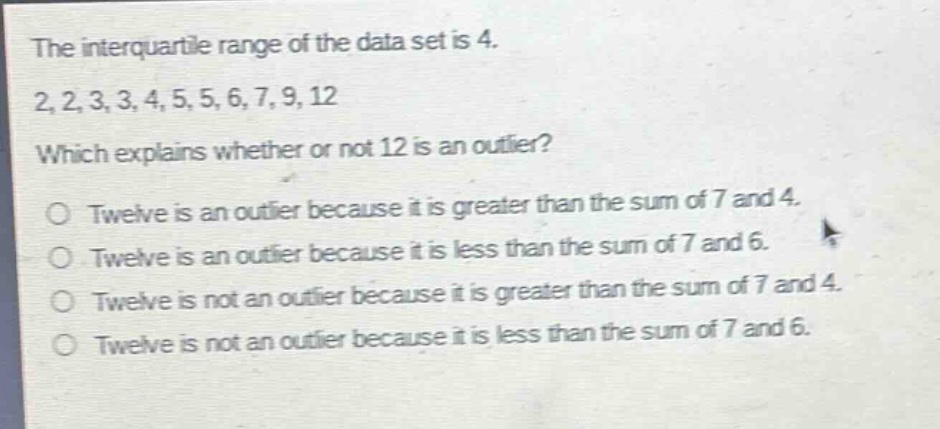
the interquartile range of the data set is 4. 2, 2, 3, 3, 4, 5, 5, 6, 7, 9, 12 which explains whether or not 12 is an outlier? o twelve is an outlier because it is greater than the sum of 7 and 4. o twelve is an outlier because it is less than the sum of 7 and 6. o twelve is not an outlier because it is greater than the sum of 7 and 4. o twelve is not an outlier because it is less than the sum of 7 and 6.
Answer
Answer:
A. Twelve is an outlier because it is greater than the sum of 7 and 4.
Explanation:
Step1: Recall outlier rule
An outlier in a data - set can be determined using the inter - quartile range (IQR). A value is considered an outlier if it is greater than $Q_3+ 1.5\times IQR$ or less than $Q_1 - 1.5\times IQR$. Here, assume the third - quartile $Q_3 = 7$ (a common way to estimate quartiles for small data sets) and $IQR = 4$.
Step2: Calculate upper bound for non - outliers
The upper bound for non - outliers is $Q_3+1.5\times IQR=7 + 1.5\times4=7 + 6=13$. Also, a simple check can be made by considering $Q_3+IQR$. Since $Q_3 = 7$ and $IQR = 4$, $Q_3+IQR=7 + 4 = 11$. The value 12 is greater than $7 + 4$, so it is an outlier.