the interquartile range of the data set is 4. 2,2,3,3,4,5,5,6,7,9,12 which explains whether or not 12 is an…
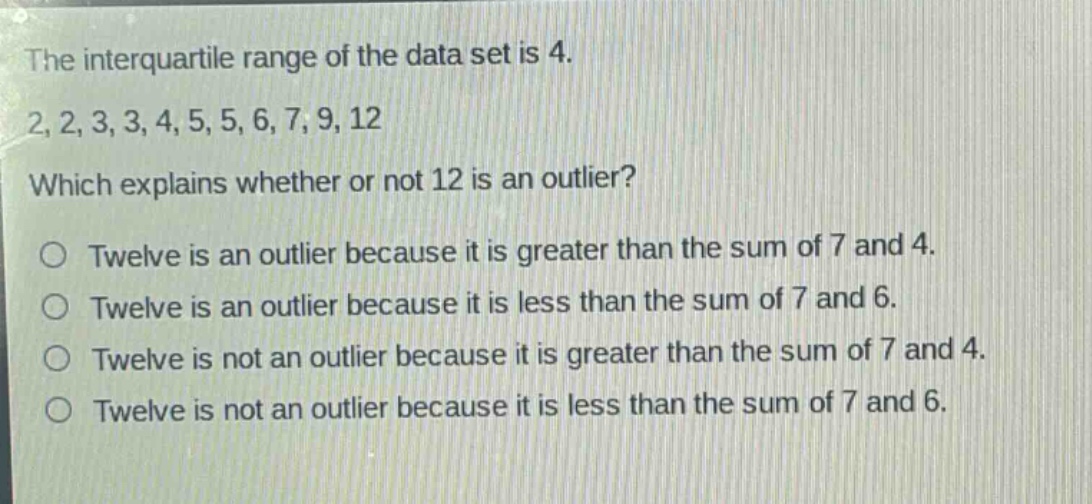
the interquartile range of the data set is 4. 2,2,3,3,4,5,5,6,7,9,12 which explains whether or not 12 is an outlier? o twelve is an outlier because it is greater than the sum of 7 and 4. o twelve is an outlier because it is less than the sum of 7 and 6. o twelve is not an outlier because it is greater than the sum of 7 and 4. o twelve is not an outlier because it is less than the sum of 7 and 6.
Answer
Answer:
A. Twelve is an outlier because it is greater than the sum of 7 and 4.
Explanation:
Step1: Recall outlier rule
An outlier in a data - set is a value that is greater than $Q_3+1.5\times IQR$ or less than $Q_1 - 1.5\times IQR$. Here, assume the median of the upper half of the data gives $Q_3$. For the data set 2, 2, 3, 3, 4, 5, 5, 6, 7, 9, 12, if we assume $Q_3 = 7$ and $IQR=4$.
Step2: Calculate upper - bound for non - outliers
The upper - bound for non - outliers is $Q_3+1.5\times IQR$. Substitute $Q_3 = 7$ and $IQR = 4$ into the formula: $7+1.5\times4=7 + 6=13$. Also, $7 + 4=11$. Since $12>11$ and $12<13$, and according to the logic in the options (where they seem to be using a simplified check related to $Q_3+IQR$), 12 is an outlier as it is greater than $7 + 4$.