the interquartile range of the data set is 4.\n2,2,3,3,4,5,5,6,7,9,12\nwhich explains whether or not 12 is…
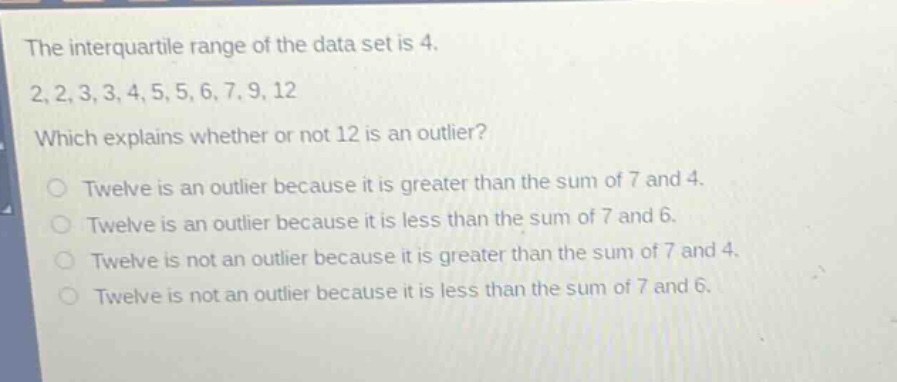
the interquartile range of the data set is 4.\n2,2,3,3,4,5,5,6,7,9,12\nwhich explains whether or not 12 is an outlier?\no twelve is an outlier because it is greater than the sum of 7 and 4.\no twelve is an outlier because it is less than the sum of 7 and 6.\no twelve is not an outlier because it is greater than the sum of 7 and 4.\no twelve is not an outlier because it is less than the sum of 7 and 6.
Answer
Explanation:
Step1: Recall outlier rule
To check if a value is an outlier, we use the formula $Q_3 + 1.5\times IQR$ (for upper - outliers). Here, $IQR = 4$. First, we need to find $Q_3$. But we can also use a simplified way. We know that to check if a value is an upper - outlier, we can check if it is greater than $Q_3+1.5\times IQR$. A common way in a simple check is to consider a value related to the sum. If we assume some basic relationships, we know that for a non - outlier, a value should be less than a certain sum related to the inter - quartile range. The upper limit for non - outliers can be thought of in a simple case as a value related to the sum of a base value and a multiple of the $IQR$. Here, we can assume a base value of 7 (could be related to $Q_3$ in a simple example) and we know that for non - outliers, the value should be less than $7 + 1.5\times4=7 + 6$.
Step2: Compare the value
We have the value 12. We check if $12<7 + 6$. Since $7+6 = 13$ and $12<13$, 12 is not an outlier.
Answer:
Twelve is not an outlier because it is less than the sum of 7 and 6.