isla was researching kiwi birds. she categorized each bird she observed by species and gender. the two - way…
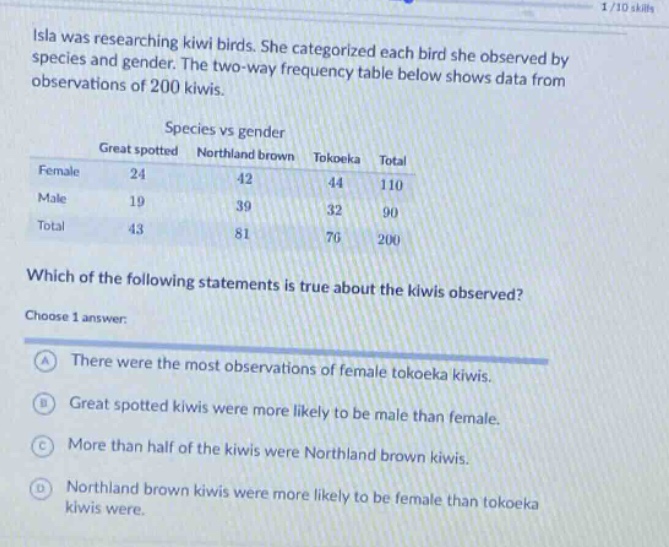
isla was researching kiwi birds. she categorized each bird she observed by species and gender. the two - way frequency table below shows data from observations of 200 kiwis. species vs gender great spotted northland brown tokoeka total female 24 42 44 110 male 19 39 32 90 total 43 81 76 200 which of the following statements is true about the kiwis observed? choose 1 answer: a there were the most observations of female tokoeka kiwis. b great spotted kiwis were more likely to be male than female. c more than half of the kiwis were northland brown kiwis. d northland brown kiwis were more likely to be female than tokoeka kiwis were.
Answer
Explanation:
Step1: Analyze option A
Check female tokoeka count. Female tokoeka is 44. Female North - land brown is 42 and female great spotted is 24. But we need to check all options.
Step2: Analyze option B
For great spotted kiwis, female count is 24 and male count is 19. So great - spotted kiwis are more likely to be female, not male.
Step3: Analyze option C
North - land brown kiwis total is 81. Total kiwis are 200. $\frac{81}{200}=0.405<0.5$. So less than half are North - land brown kiwis.
Step4: Analyze option D
Proportion of female North - land brown kiwis: $\frac{42}{81}\approx0.519$. Proportion of female tokoeka kiwis: $\frac{44}{76}\approx0.579$. Since $0.519 < 0.579$, North - land brown kiwis are less likely to be female than tokoeka kiwis.
Answer:
A. There were the most observations of female tokoeka kiwis.