james surveyed people at school and asked whether they bring their lunch to school or buy their lunch at…
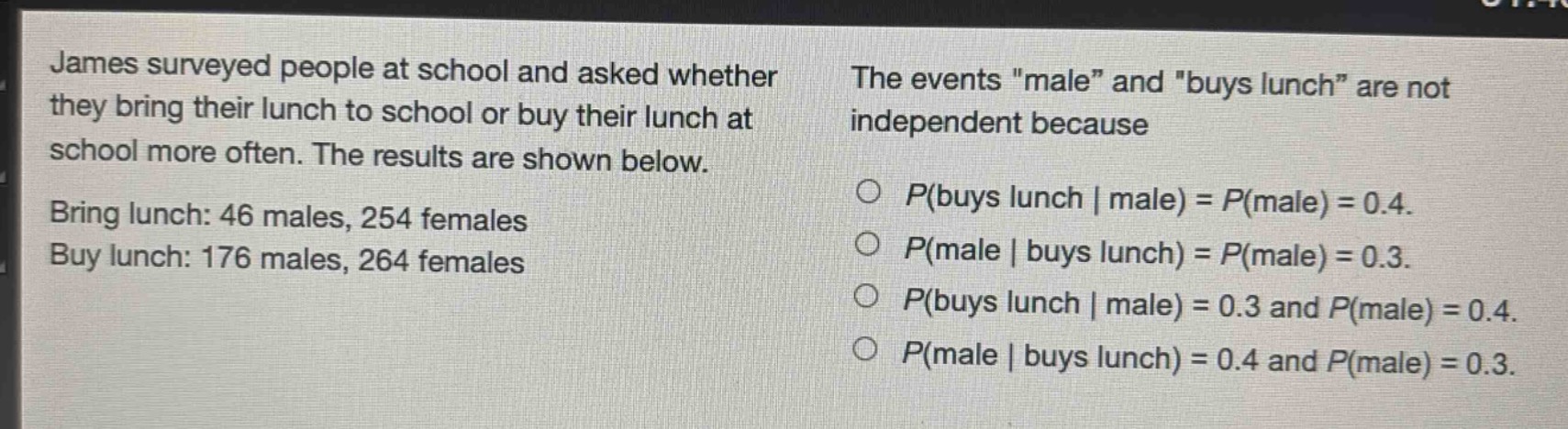
james surveyed people at school and asked whether they bring their lunch to school or buy their lunch at school more often. the results are shown below. bring lunch: 46 males, 254 females. buy lunch: 176 males, 264 females. the events \male\ and \buys lunch\ are not independent because o $p(buys lunch | male)=p(male)=0.4$. o $p(male | buys lunch)=p(male)=0.3$. o $p(buys lunch | male)=0.3$ and $p(male)=0.4$. o $p(male | buys lunch)=0.4$ and $p(male)=0.3$.
Answer
Explanation:
Step1: Calculate total number of people
Total number of people = (46 + 254+176 + 264=740).
Step2: Calculate (P(\text{male}))
Number of males = (46 + 176=222). So (P(\text{male})=\frac{222}{740}=0.3).
Step3: Calculate (P(\text{buys lunch and male}))
Number of males who buy lunch = (176). So (P(\text{buys lunch and male})=\frac{176}{740}).
Step4: Calculate (P(\text{buys lunch}|\text{male}))
By the formula (P(A|B)=\frac{P(A\cap B)}{P(B)}), (P(\text{buys lunch}|\text{male})=\frac{\frac{176}{740}}{\frac{222}{740}}=\frac{176}{222}\approx0.793) (not relevant for our answer - we focus on male - related conditional and marginal probabilities).
Step5: Calculate (P(\text{male}|\text{buys lunch}))
Number of people who buy lunch = (176 + 264 = 440). So (P(\text{male}|\text{buys lunch})=\frac{176}{440}=0.4).
Answer:
(P(\text{male}|\text{buys lunch}) = 0.4) and (P(\text{male}) = 0.3). So the answer is the last option.