jana collects the quarters from a fountain every day for ten days. the table shows the number of quarters…
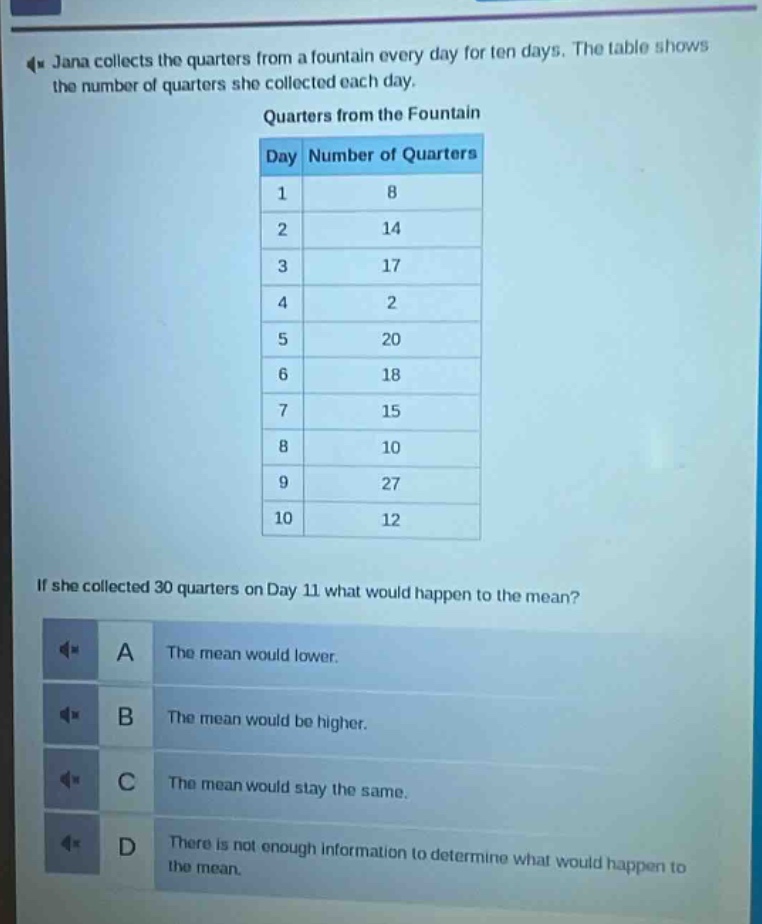
jana collects the quarters from a fountain every day for ten days. the table shows the number of quarters she collected each day.\nquarters from the fountain\n| day | number of quarters |\n| ---- | ---- |\n| 1 | 8 |\n| 2 | 14 |\n| 3 | 17 |\n| 4 | 2 |\n| 5 | 20 |\n| 6 | 18 |\n| 7 | 15 |\n| 8 | 10 |\n| 9 | 27 |\n| 10 | 12 |\nif she collected 30 quarters on day 11 what would happen to the mean?\na the mean would lower.\nb the mean would be higher.\nc the mean would stay the same.\nd there is not enough information to determine what would happen to the mean.
Answer
Explanation:
Step1: Calculate initial mean
The sum of quarters for first 10 days is $8 + 14+17+2+20+18+15+10+27+12=143$. The initial mean $\bar{x}_1=\frac{143}{10} = 14.3$.
Step2: Calculate new mean
After Day 11, the sum of quarters is $143 + 30=173$, and the number of days is $n = 11$. The new mean $\bar{x}_2=\frac{173}{11}\approx15.73$.
Step3: Compare means
Since $15.73>14.3$, the mean would be higher.
Answer:
B. The mean would be higher.