a jar contained 12 red marbles, 16 green marbles, and 10 blue marbles. a marble was selected at random, the…
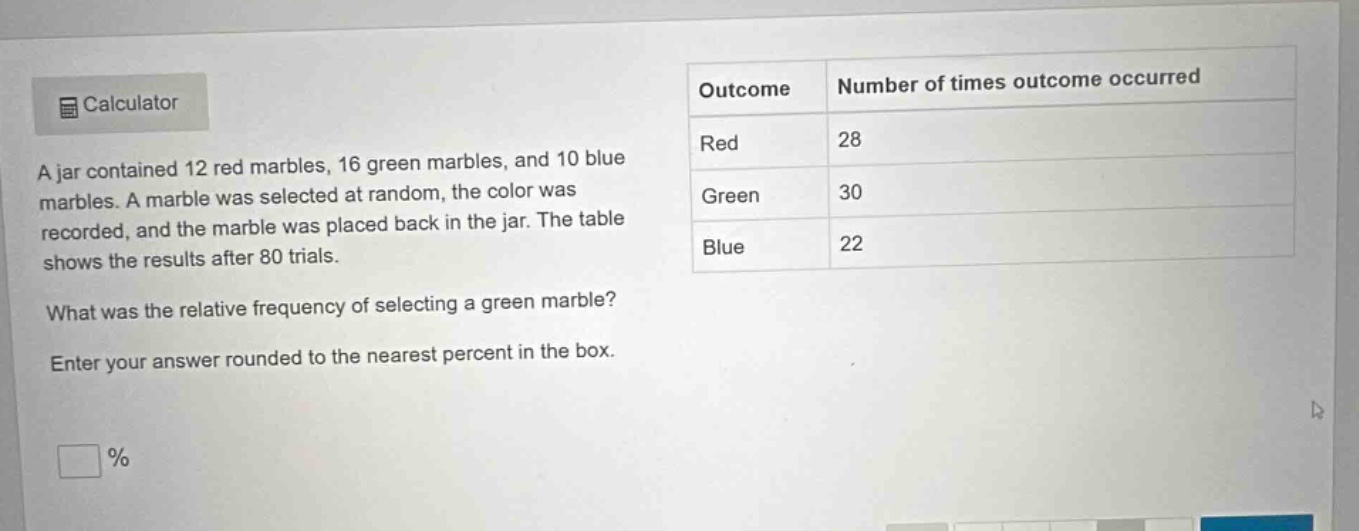
a jar contained 12 red marbles, 16 green marbles, and 10 blue marbles. a marble was selected at random, the color was recorded, and the marble was placed back in the jar. the table shows the results after 80 trials. what was the relative frequency of selecting a green marble? enter your answer rounded to the nearest percent in the box.
Answer
Explanation:
Step1: Recall relative - frequency formula
Relative frequency = $\frac{\text{Number of times event occurred}}{\text{Total number of trials}}$
Step2: Identify values from the problem
The number of times a green marble was selected is 30, and the total number of trials is 80.
Step3: Calculate relative frequency
Relative frequency of selecting a green marble = $\frac{30}{80}= 0.375$
Step4: Convert to percentage
$0.375\times100% = 37.5%$
Step5: Round to the nearest percent
Rounding 37.5% to the nearest percent gives 38%
Answer:
38%