a jar contains 11 green marbles, 7 red marbles, and 6 blue marbles. a marble is selected at random, not…
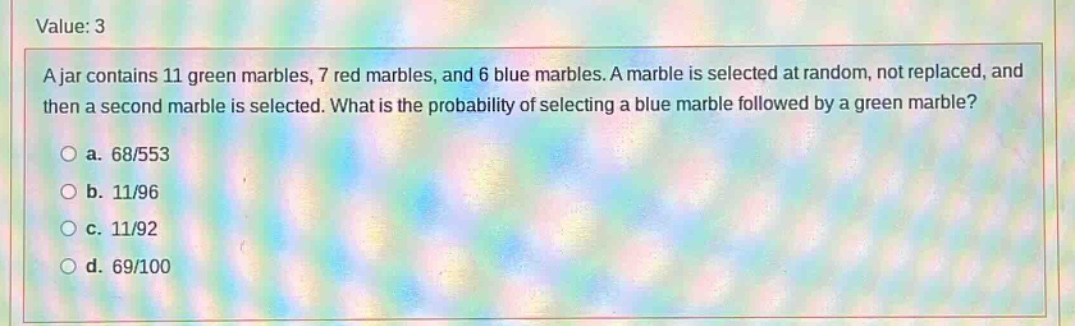
a jar contains 11 green marbles, 7 red marbles, and 6 blue marbles. a marble is selected at random, not replaced, and then a second marble is selected. what is the probability of selecting a blue marble followed by a green marble?\n\na. 68/553\n\nb. 11/96\n\nc. 11/92\n\nd. 69/100
Answer
Explanation:
Step1: Calculate probability of first - blue marble
The total number of marbles initially is $11 + 7+6=24$. The number of blue marbles is 6. So the probability of selecting a blue marble first, $P(B_1)=\frac{6}{24}$.
Step2: Calculate probability of second - green marble
After one blue marble is selected and not replaced, the total number of marbles left is $24 - 1 = 23$, and the number of green marbles is 11. So the probability of selecting a green marble second given a blue marble was selected first, $P(G_2|B_1)=\frac{11}{23}$.
Step3: Calculate joint probability
By the multiplication rule for dependent events $P(B_1\cap G_2)=P(B_1)\times P(G_2|B_1)=\frac{6}{24}\times\frac{11}{23}=\frac{6\times11}{24\times23}=\frac{66}{552}=\frac{11}{92}$.
Answer:
C. 11/92