a jar contains 11 red marbles, 12 blue marbles, and 6 white marbles. four marbles from this jar are…
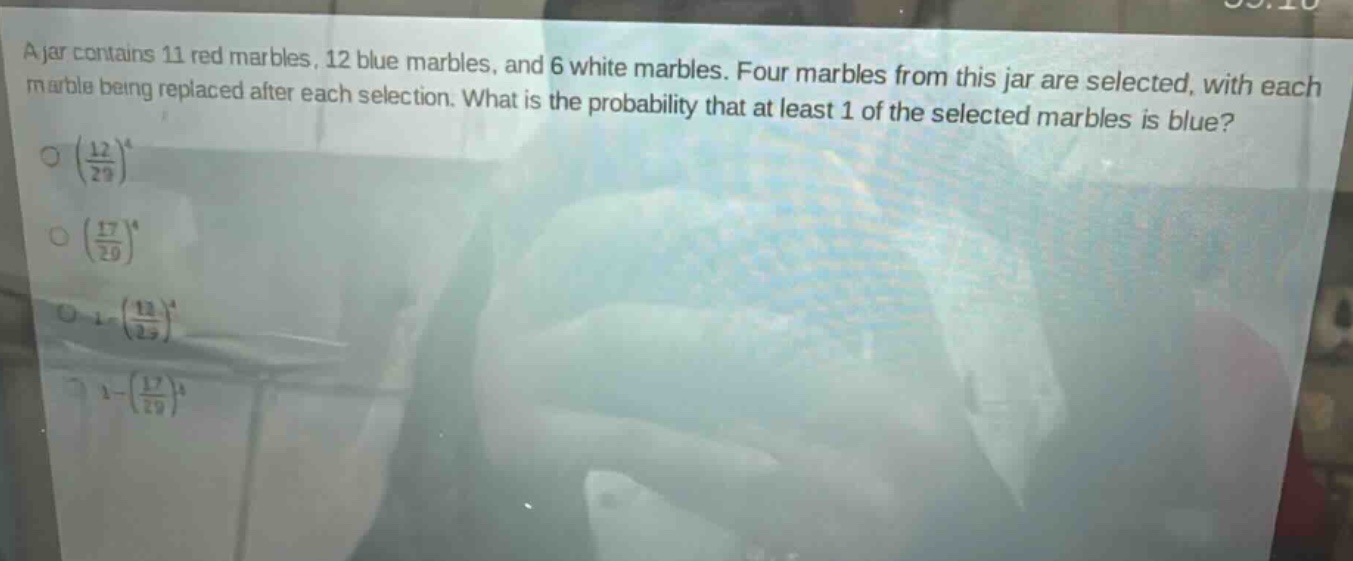
a jar contains 11 red marbles, 12 blue marbles, and 6 white marbles. four marbles from this jar are selected, with each marble being replaced after each selection. what is the probability that at least 1 of the selected marbles is blue?\n$\\left(\\frac{12}{29}\\right)^4$\n$\\left(\\frac{17}{29}\\right)^4$\n$1 - \\left(\\frac{12}{29}\\right)^4$\n$1 - \\left(\\frac{17}{29}\\right)^4$
Answer
Explanation:
Step1: Calculate total number of marbles
The total number of marbles is $11 + 12+6=29$.
Step2: Calculate the probability of not - getting a blue marble in one draw
The number of non - blue marbles is $11 + 6=17$. The probability of not getting a blue marble in one draw is $p=\frac{17}{29}$.
Step3: Calculate the probability of not getting a blue marble in 4 draws
Since the draws are independent (because of replacement), the probability of not getting a blue marble in 4 draws is $(\frac{17}{29})^4$.
Step4: Calculate the probability of getting at least 1 blue marble
The probability of getting at least 1 blue marble is the complement of the probability of getting no blue marbles. So it is $1 - (\frac{17}{29})^4$.
Answer:
$1 - (\frac{17}{29})^4$