a jar contains 11 red marbles, 12 blue marbles, and 6 white marbles. four marbles from this jar are…
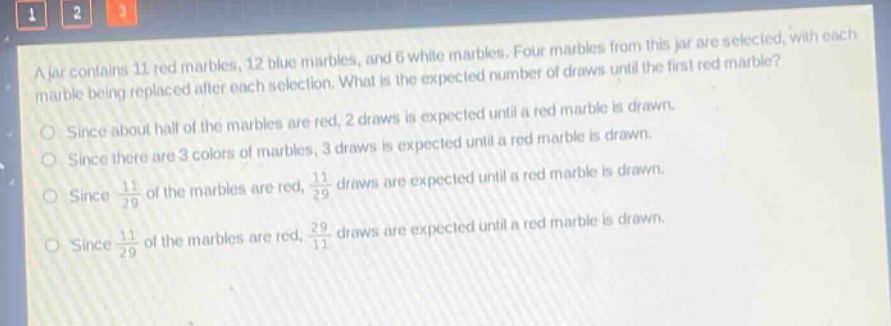
a jar contains 11 red marbles, 12 blue marbles, and 6 white marbles. four marbles from this jar are selected, with each marble being replaced after each selection. what is the expected number of draws until the first red marble?\nsince about half of the marbles are red, 2 draws is expected until a red marble is drawn.\nsince there are 3 colors of marbles, 3 draws is expected until a red marble is drawn.\nsince $\frac{11}{29}$ of the marbles are red, $\frac{11}{29}$ draws are expected until a red marble is drawn.\nsince $\frac{11}{29}$ of the marbles are red, $\frac{29}{11}$ draws are expected until a red marble is drawn.
Answer
Answer:
Since $\frac{11}{29}$ of the marbles are red, $\frac{29}{11}$ draws are expected until a red marble is drawn.
Explanation:
Step1: Calculate total number of marbles
$11 + 12+6=29$
Step2: Determine probability of drawing red
Probability $p=\frac{11}{29}$
Step3: Recall expected - value formula for geometric distribution
For a geometric distribution, the expected number of trials $E(X)$ until the first success (drawing a red marble here) is given by $E(X)=\frac{1}{p}$.
Step4: Calculate expected number of draws
$E(X)=\frac{1}{\frac{11}{29}}=\frac{29}{11}$