a jar contains only one blue tile, one green tile, one red tile, and one yellow tile. if a tile is chosen at…
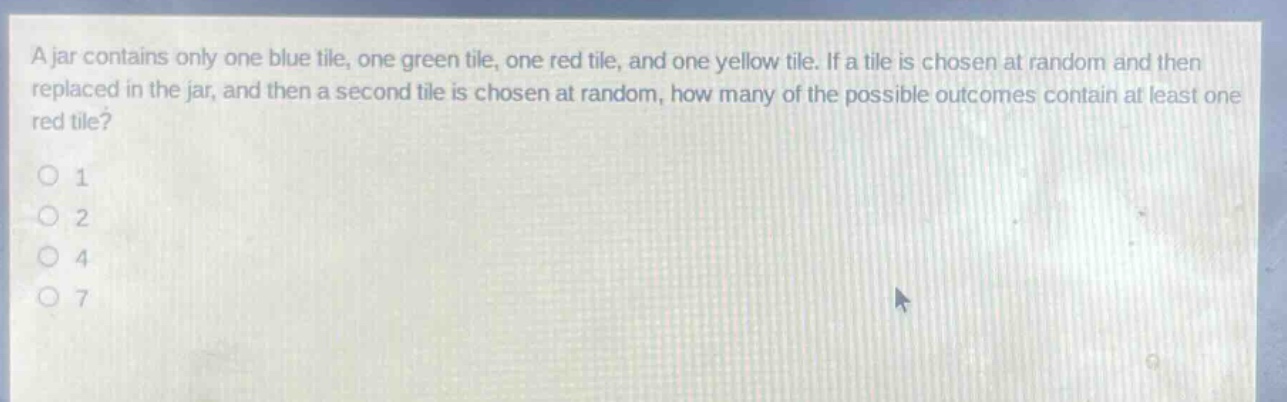
a jar contains only one blue tile, one green tile, one red tile, and one yellow tile. if a tile is chosen at random and then replaced in the jar, and then a second tile is chosen at random, how many of the possible outcomes contain at least one red tile?\n1\n2\n4\n7
Answer
Answer:
D. 7
Explanation:
Step1: Calculate total outcomes
Since there are 4 tiles and replacement is allowed, the total number of possible outcomes for two - tile draws is $4\times4 = 16$ (by the multiplication principle, as there are 4 choices for the first draw and 4 choices for the second draw).
Step2: Calculate outcomes with no red tiles
If we exclude the red tile, there are 3 non - red tiles. The number of outcomes with no red tiles in two draws is $3\times3=9$ (3 choices for the first non - red draw and 3 choices for the second non - red draw).
Step3: Calculate outcomes with at least one red tile
We use the principle of complementary counting. The number of outcomes with at least one red tile is the total number of outcomes minus the number of outcomes with no red tiles. So, $16 - 9=7$.