a jar contains 4 white chips, 5 purple chips, and 1 black chip. chips are selected randomly one at a time…
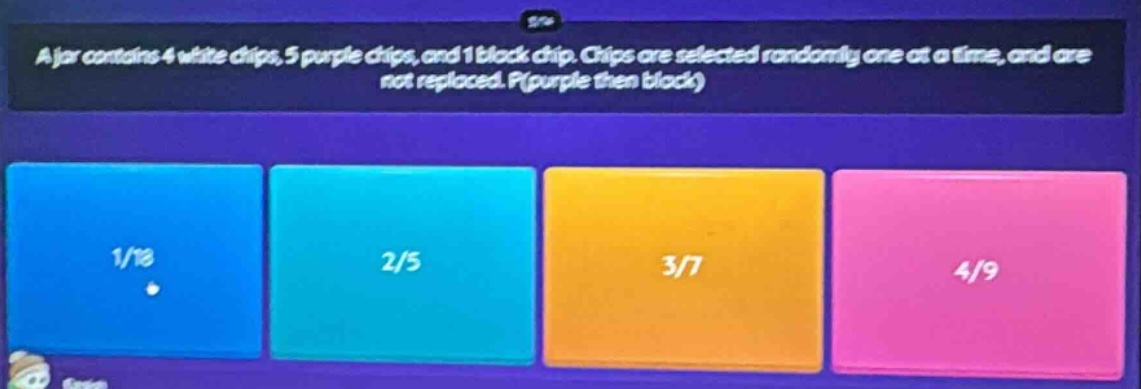
a jar contains 4 white chips, 5 purple chips, and 1 black chip. chips are selected randomly one at a time, and are not replaced. p(purple then black)
Answer
Explanation:
Step1: Calculate probability of first - purple
The total number of chips is (4 + 5+1=10). The number of purple chips is 5. So the probability of selecting a purple chip first, (P(\text{purple}_1)=\frac{5}{10}).
Step2: Calculate probability of second - black given first - purple
After selecting a purple chip first, there are (10 - 1 = 9) chips left. The number of black chips is 1. So the probability of selecting a black chip second given a purple chip was selected first, (P(\text{black}_2|\text{purple}_1)=\frac{1}{9}).
Step3: Calculate joint probability
By the multiplication rule for dependent events (P(A\text{ then }B)=P(A)\times P(B|A)). Here (A) is the event of selecting a purple chip first and (B) is the event of selecting a black chip second. So (P(\text{purple then black})=\frac{5}{10}\times\frac{1}{9}=\frac{5}{90}=\frac{1}{18}).
Answer:
A. (1/18)