a jar has an equal number of red (r), blue(b), orange (o), yellow (y), and green (g) marbles. a marble is…
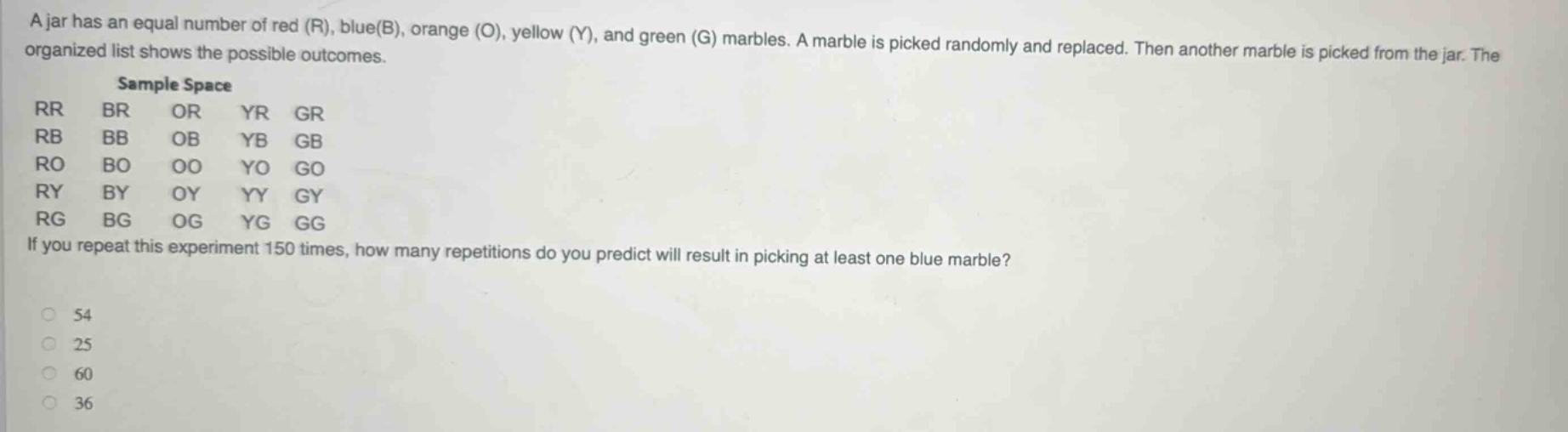
a jar has an equal number of red (r), blue(b), orange (o), yellow (y), and green (g) marbles. a marble is picked randomly and replaced. then another marble is picked from the jar. the organized list shows the possible outcomes. sample space rr br or yr gr rb bb ob yb gb ro bo oo yo go ry by oy yy gy rg bg og yg gg if you repeat this experiment 150 times, how many repetitions do you predict will result in picking at least one blue marble? 54 25 60 36
Answer
Explanation:
Step1: Find total number of outcomes
There are 5 colors of marbles. When picking two - marbles with replacement, the total number of outcomes in the sample space is $5\times5 = 25$ (by the multiplication principle).
Step2: Find number of outcomes with no blue marbles
If we exclude blue marbles, there are 4 colors. The number of outcomes with no blue marbles when picking two marbles is $4\times4=16$.
Step3: Find number of outcomes with at least one blue marble
The number of outcomes with at least one blue marble is the total number of outcomes minus the number of outcomes with no blue marbles. So, $25 - 16=9$.
Step4: Calculate the predicted number of repetitions
The probability of getting at least one blue marble in a single trial is $\frac{9}{25}$. If the experiment is repeated 150 times, the predicted number of repetitions with at least one blue marble is $150\times\frac{9}{25}=54$.
Answer:
54