3. jared has mowed \\(\\frac{2}{5}\\) of the yard. abby says that jared has mowed \\(\\frac{4}{6}\\) of the…
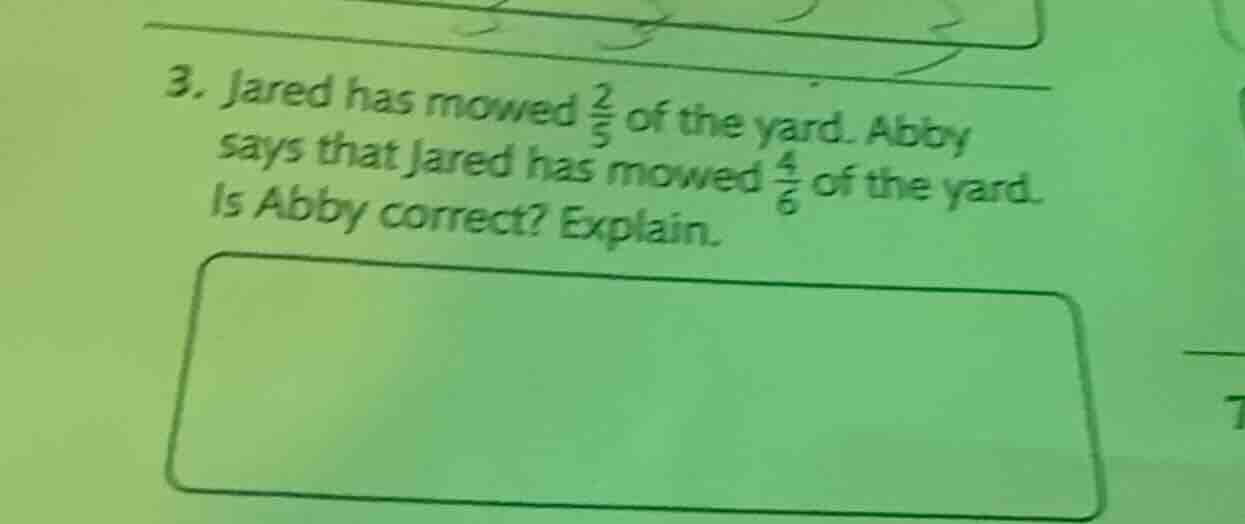
3. jared has mowed \\(\\frac{2}{5}\\) of the yard. abby says that jared has mowed \\(\\frac{4}{6}\\) of the yard. is abby correct? explain.
Answer
Explanation:
Step1: Simplify (\frac{4}{6})
To simplify (\frac{4}{6}), we divide the numerator and the denominator by their greatest common divisor, which is 2. So, (\frac{4\div2}{6\div2}=\frac{2}{3}).
Step2: Compare (\frac{2}{5}) and (\frac{2}{3})
When two fractions have the same numerator, the fraction with the smaller denominator is larger. Here, the numerators are both 2, and (5>3), so (\frac{2}{5}<\frac{2}{3}). Also, we can find a common denominator, which is 15. (\frac{2}{5}=\frac{2\times3}{5\times3}=\frac{6}{15}) and (\frac{2}{3}=\frac{2\times5}{3\times5}=\frac{10}{15}). Since (\frac{6}{15}\neq\frac{10}{15}), (\frac{2}{5}) is not equal to (\frac{4}{6}) (which simplifies to (\frac{2}{3})).
Answer:
Abby is not correct. Because (\frac{4}{6}) simplifies to (\frac{2}{3}), and (\frac{2}{5}) (the fraction of the yard Jared actually mowed) is not equal to (\frac{2}{3}) (the fraction Abby claims he mowed). We can show this by simplifying (\frac{4}{6}) to (\frac{2}{3}) or by finding a common denominator (15) and seeing that (\frac{2}{5}=\frac{6}{15}) and (\frac{2}{3}=\frac{10}{15}), and (\frac{6}{15}\neq\frac{10}{15}).