jarek said that the probability of rolling an even number on a six - sided dice is $\frac{1}{2}$, then he…
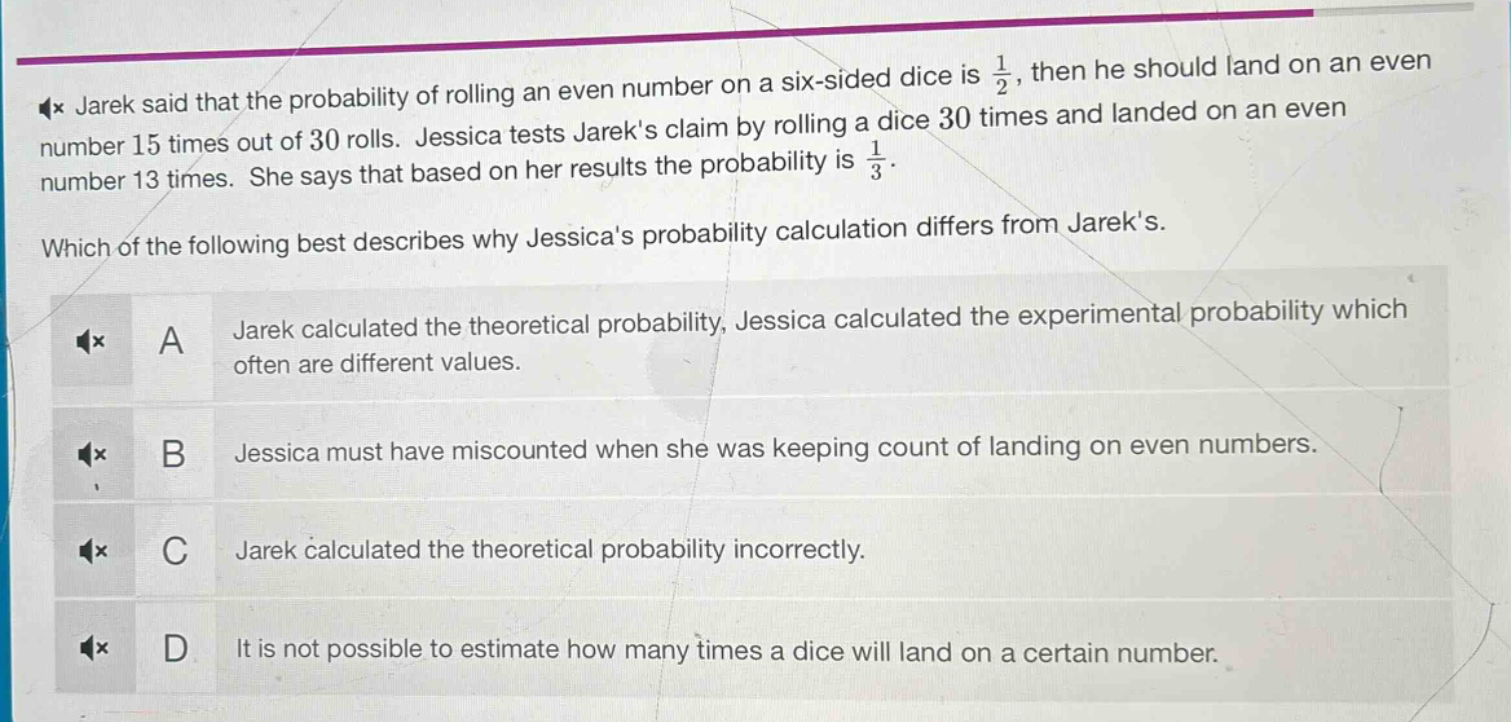
jarek said that the probability of rolling an even number on a six - sided dice is $\frac{1}{2}$, then he should land on an even number 15 times out of 30 rolls. jessica tests jareks claim by rolling a dice 30 times and landed on an even number 13 times. she says that based on her results the probability is $\frac{1}{3}$. which of the following best describes why jessicas probability calculation differs from jareks. a jarek calculated the theoretical probability, jessica calculated the experimental probability which often are different values. b jessica must have miscounted when she was keeping count of landing on even numbers. c jarek calculated the theoretical probability incorrectly. d it is not possible to estimate how many times a dice will land on a certain number.
Answer
Brief Explanations:
Jarek found the theoretical probability of getting an even - numbered roll on a six - sided die (3 even numbers out of 6, so $\frac{3}{6}=\frac{1}{2}$). Jessica rolled the die 30 times and calculated the experimental probability based on her results ($\frac{13}{30}\approx\frac{1}{3}$). Experimental and theoretical probabilities often differ due to the random nature of experiments.
Answer:
A. Jarek calculated the theoretical probability, Jessica calculated the experimental probability which often are different values.