jason bought 10 of the 30 raffle tickets for a drawing. assuming that he chooses the winning ticket each…
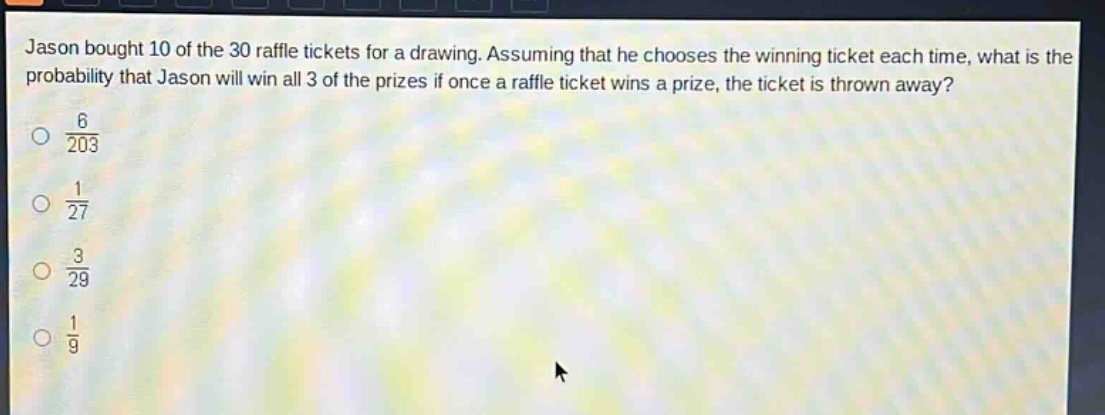
jason bought 10 of the 30 raffle tickets for a drawing. assuming that he chooses the winning ticket each time, what is the probability that jason will win all 3 of the prizes if once a raffle ticket wins a prize, the ticket is thrown away?\n$\frac{6}{203}$\n$\frac{1}{27}$\n$\frac{3}{29}$\n$\frac{1}{9}$
Answer
Explanation:
Step1: Calculate first - draw probability
The probability that Jason wins the first prize is the ratio of the number of his tickets to the total number of tickets. He has 10 tickets out of 30, so the probability $P_1=\frac{10}{30}$.
Step2: Calculate second - draw probability
After winning the first prize, his ticket is thrown away. So there are 9 of his tickets left and 29 total tickets left. The probability that he wins the second prize is $P_2 = \frac{9}{29}$.
Step3: Calculate third - draw probability
After winning the first two prizes, there are 8 of his tickets left and 28 total tickets left. The probability that he wins the third prize is $P_3=\frac{8}{28}$.
Step4: Calculate the probability of winning all three prizes
Since these are independent - dependent events, the probability of winning all three prizes is the product of the probabilities of winning each individual prize. $P = P_1\times P_2\times P_3=\frac{10}{30}\times\frac{9}{29}\times\frac{8}{28}=\frac{10\times9\times8}{30\times29\times28}=\frac{720}{24360}=\frac{6}{203}$.
Answer:
$\frac{6}{203}$