when jeremy surveyed thirty 7th - grade students at the community pool, he found that 2/15 had not read at…
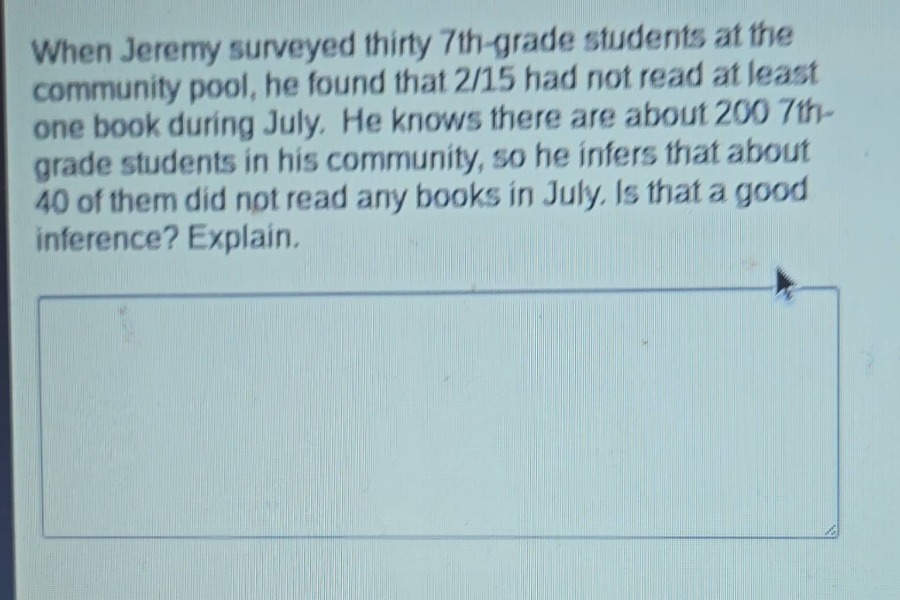
when jeremy surveyed thirty 7th - grade students at the community pool, he found that 2/15 had not read at least one book during july. he knows there are about 200 7th - grade students in his community, so he infers that about 40 of them did not read any books in july. is that a good inference? explain.
Answer
Explanation:
Step1: Calculate expected number
Find the expected number of non - reading students in the whole community using the proportion from the sample. The proportion of non - reading students in the sample is $\frac{2}{15}$, and the total number of 7th - grade students in the community is 200. So the expected number is $200\times\frac{2}{15}=\frac{400}{15}=\frac{80}{3}\approx26.67$.
Step2: Compare with inferred number
Jeremy inferred 40 students did not read any books. Since the calculated expected number is approximately 26.67 and 40 is quite different from it, it is not a good inference.
Answer:
No, it is not a good inference because when calculating the expected number of 7th - grade students who did not read any books in July using the proportion from the sample, we get approximately 26.67, which is quite different from the inferred number of 40.