a jeweler had a fixed amount of gold to make bracelets and necklaces. the amount of gold in each bracelet is…
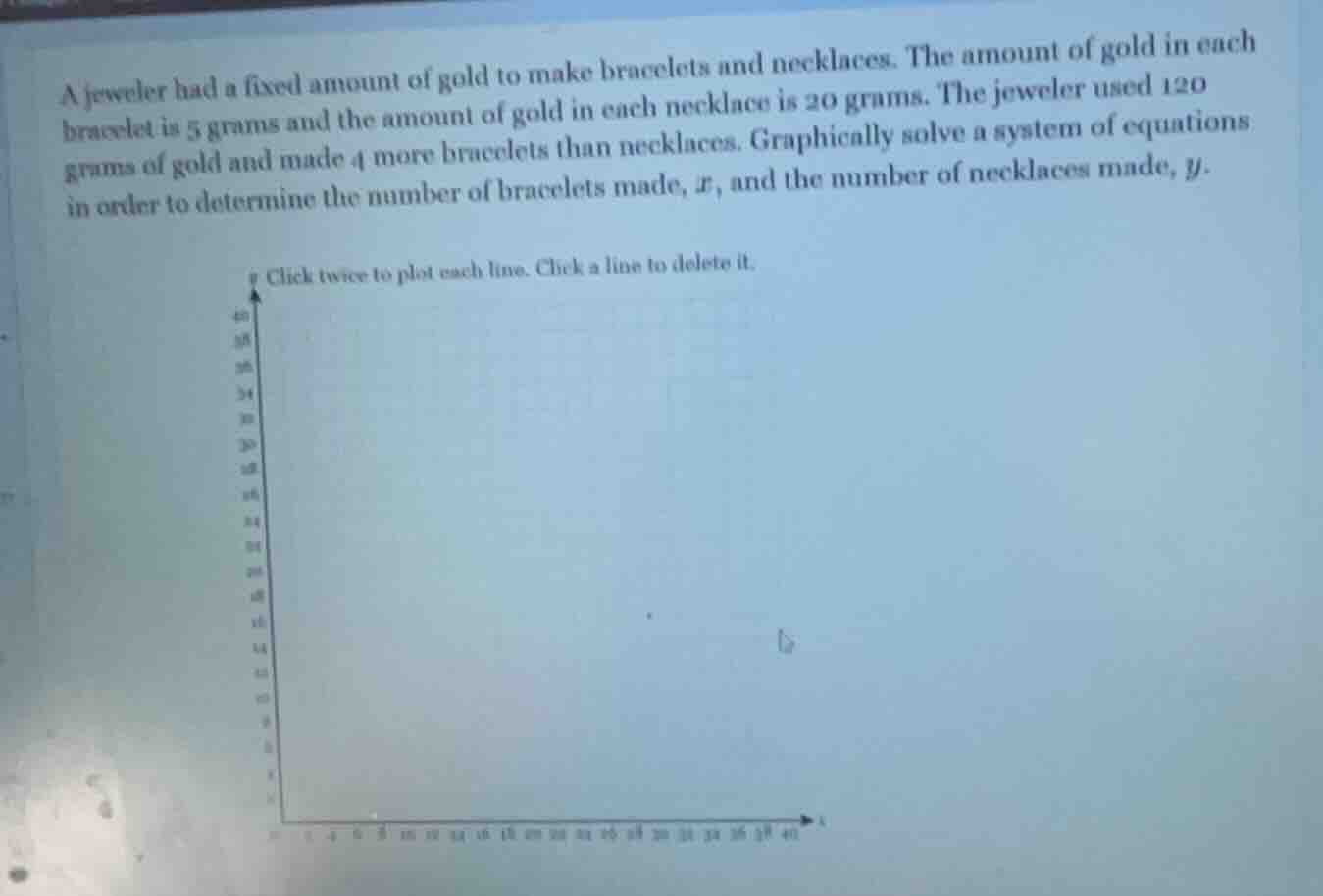
a jeweler had a fixed amount of gold to make bracelets and necklaces. the amount of gold in each bracelet is 5 grams and the amount of gold in each necklace is 20 grams. the jeweler used 120 grams of gold and made 4 more bracelets than necklaces. graphically solve a system of equations in order to determine the number of bracelets made, $x$, and the number of necklaces made, $y$.\nclick twice to plot each line. click a line to delete it.
Answer
Explanation:
Step1: Define equations from problem
First equation (gold usage): $5x + 20y = 120$ Second equation (quantity difference): $x = y + 4$
Step2: Simplify first equation
Divide by 5: $x + 4y = 24$
Step3: Substitute $x=y+4$ into simplified equation
$(y + 4) + 4y = 24$ Combine like terms: $5y + 4 = 24$
Step4: Solve for $y$
Subtract 4: $5y = 20$ Divide by 5: $y = 4$
Step5: Solve for $x$
Substitute $y=4$ into $x=y+4$: $x = 4 + 4 = 8$
Step6: Graph the lines (for verification)
- For $x + 4y = 24$:
- When $x=0$, $4y=24 \implies y=6$ (point $(0,6)$)
- When $y=0$, $x=24$ (point $(24,0)$)
- For $x = y + 4$:
- When $y=0$, $x=4$ (point $(4,0)$)
- When $y=4$, $x=8$ (point $(8,4)$) The lines intersect at $(8,4)$.
Answer:
The number of bracelets $x=8$, and the number of necklaces $y=4$. The intersection point of the two graphed lines is $(8, 4)$.