joanie typically makes 20% of the penalty kicks she attempts. what is the probability that joanie will make…
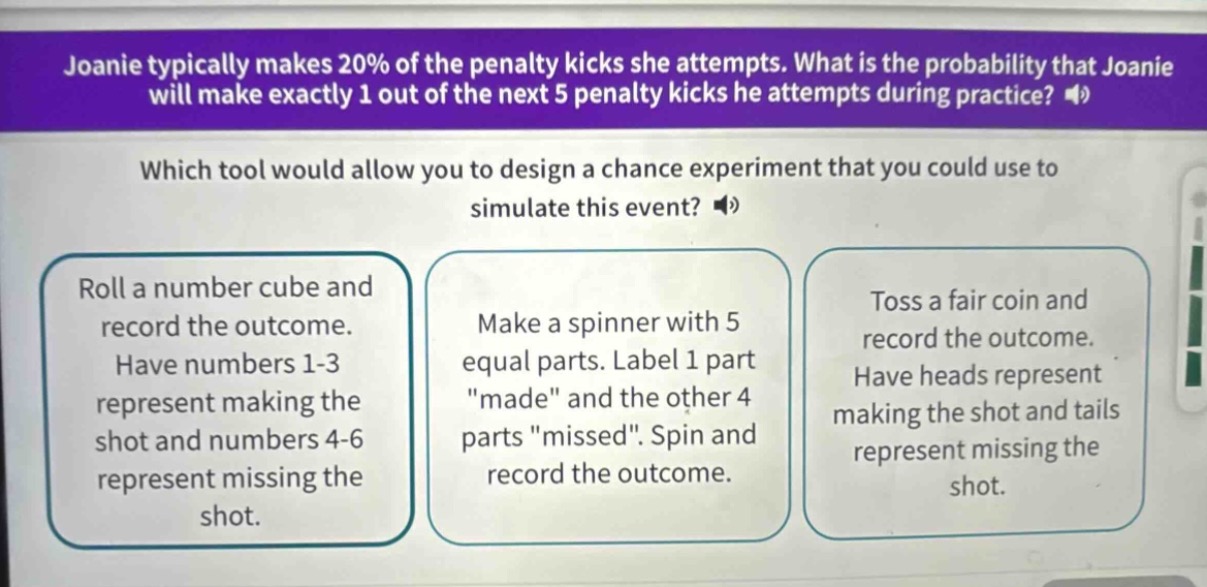
joanie typically makes 20% of the penalty kicks she attempts. what is the probability that joanie will make exactly 1 out of the next 5 penalty kicks he attempts during practice? which tool would allow you to design a chance experiment that you could use to simulate this event? roll a number cube and record the outcome. have numbers 1 - 3 represent making the shot and numbers 4 - 6 represent missing the shot. make a spinner with 5 equal parts. label 1 part \made\ and the other 4 parts \missed\. spin and record the outcome. toss a fair coin and record the outcome. have heads represent making the shot and tails represent missing the shot.
Answer
Explanation:
Step1: Analyze probability of each option
- For the number - cube option: The probability of making the shot (numbers 1 - 3) is (P=\frac{3}{6}=\frac{1}{2}=50%), which is not (20%).
- For the spinner option: The probability of making the shot (1 part out of 5) is (P = \frac{1}{5}=20%).
- For the coin - toss option: The probability of making the shot (heads) is (P=\frac{1}{2} = 50%), which is not (20%).
Answer:
The spinner (Make a spinner with 5 equal parts. Label 1 part "made" and the other 4 parts "missed". Spin and record the outcome) is the correct tool.