jordan is using a six - sided number cube to predict whether people shopping in the mall arrive by car or by…
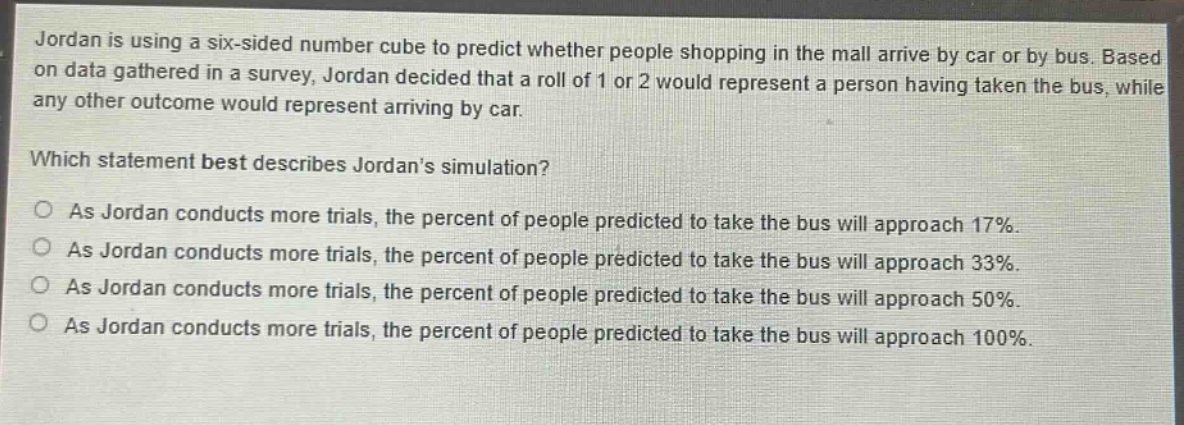
jordan is using a six - sided number cube to predict whether people shopping in the mall arrive by car or by bus. based on data gathered in a survey, jordan decided that a roll of 1 or 2 would represent a person having taken the bus, while any other outcome would represent arriving by car. which statement best describes jordans simulation? as jordan conducts more trials, the percent of people predicted to take the bus will approach 17%. as jordan conducts more trials, the percent of people predicted to take the bus will approach 33%. as jordan conducts more trials, the percent of people predicted to take the bus will approach 50%. as jordan conducts more trials, the percent of people predicted to take the bus will approach 100%.
Answer
Explanation:
Step1: Calculate probability of bus - arrival
A six - sided number cube has 6 possible outcomes. The outcomes representing taking the bus are 1 and 2, so there are 2 favorable outcomes for taking the bus. The probability of an event $P(E)=\frac{\text{Number of favorable outcomes}}{\text{Total number of outcomes}}$. So, $P(\text{taking bus})=\frac{2}{6}=\frac{1}{3}$.
Step2: Convert probability to percentage
To convert $\frac{1}{3}$ to a percentage, we calculate $\frac{1}{3}\times100%\approx 33%$. According to the law of large numbers, as the number of trials increases, the experimental probability approaches the theoretical probability.
Answer:
As Jordan conducts more trials, the percent of people predicted to take the bus will approach 33%.