josh used a standard deck of 52 cards to conduct an experiment. half of the cards in the deck were red. the…
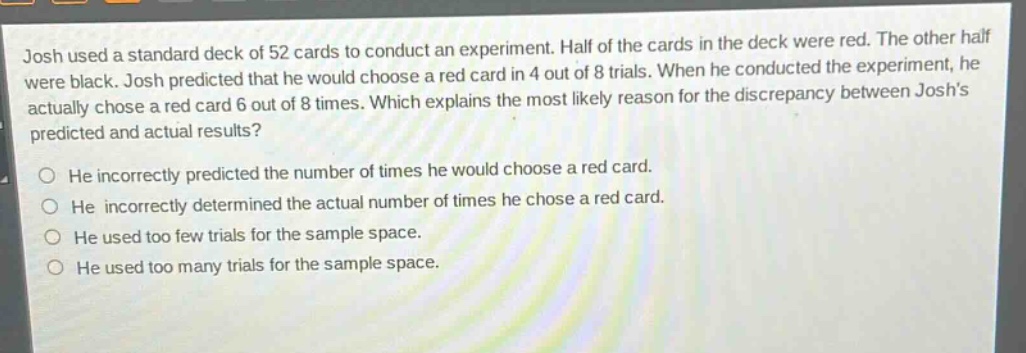
josh used a standard deck of 52 cards to conduct an experiment. half of the cards in the deck were red. the other half were black. josh predicted that he would choose a red card in 4 out of 8 trials. when he conducted the experiment, he actually chose a red card 6 out of 8 times. which explains the most likely reason for the discrepancy between joshs predicted and actual results? he incorrectly predicted the number of times he would choose a red card. he incorrectly determined the actual number of times he chose a red card. he used too few trials for the sample space. he used too many trials for the sample space.
Answer
Brief Explanations:
In probability, for more accurate results, a larger number of trials is preferred. With only 8 trials, the sample size is small, leading to possible discrepancies between predicted (theoretical) and actual (experimental) results.
Answer:
He used too few trials for the sample space.