juanita has a storage closet at her shop with extra bottles of lotion and shower gel. some are scented and…
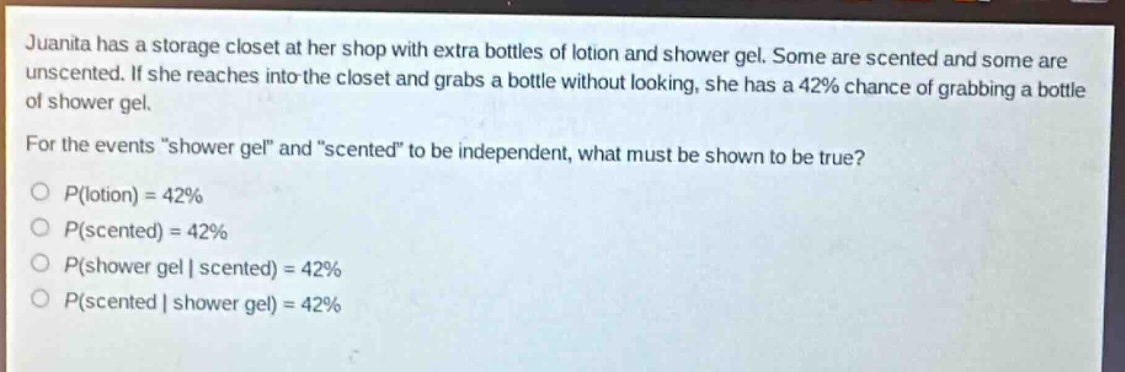
juanita has a storage closet at her shop with extra bottles of lotion and shower gel. some are scented and some are unscented. if she reaches into the closet and grabs a bottle without looking, she has a 42% chance of grabbing a bottle of shower gel. for the events “shower gel” and “scented” to be independent, what must be shown to be true?\np(lotion) = 42%\np(scented) = 42%\np(shower gel | scented) = 42%\np(scented | shower gel) = 42%
Answer
Explanation:
Step1: Recall independence formula
Two events (A) and (B) are independent if (P(A|B)=P(A)) and (P(B|A) = P(B)). Let event (A) be "shower - gel" and event (B) be "scented". We know that (P(A) = 42%).
Step2: Apply independence condition
For events "shower gel" and "scented" to be independent, the probability of getting a shower - gel given that it is scented should be equal to the probability of getting a shower - gel. That is (P(\text{shower gel}|\text{scented})=P(\text{shower gel})). Since (P(\text{shower gel}) = 42%), we must have (P(\text{shower gel}|\text{scented})=42%).
Answer:
(P(\text{shower gel}|\text{scented}) = 42%)