in juneau, alaska, the 30 - year annual snowfall average is 86.7 inches with a standard deviation of 40.4…
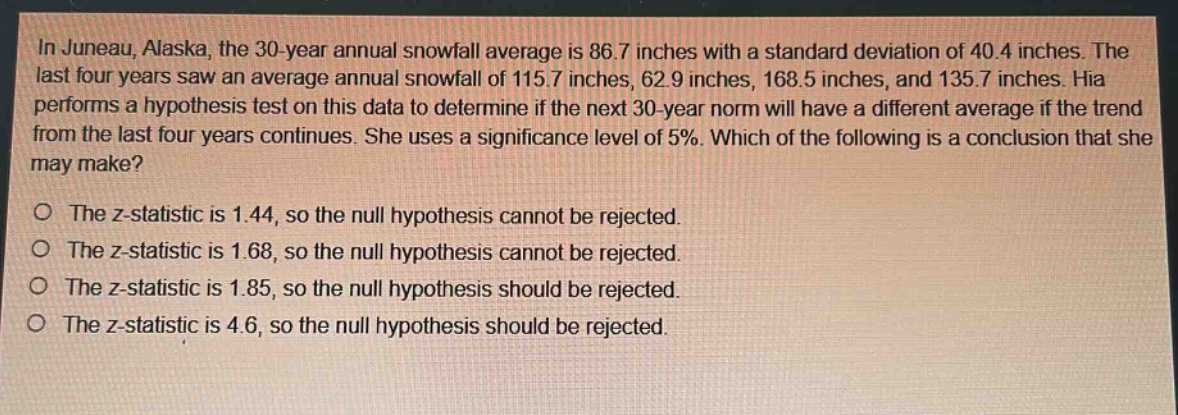
in juneau, alaska, the 30 - year annual snowfall average is 86.7 inches with a standard deviation of 40.4 inches. the last four years saw an average annual snowfall of 115.7 inches, 62.9 inches, 168.5 inches, and 135.7 inches. hia performs a hypothesis test on this data to determine if the next 30 - year norm will have a different average if the trend from the last four years continues. she uses a significance level of 5%. which of the following is a conclusion that she may make?\no the z - statistic is 1.44, so the null hypothesis cannot be rejected.\no the z - statistic is 1.68, so the null hypothesis cannot be rejected.\no the z - statistic is 1.85, so the null hypothesis should be rejected.\no the z - statistic is 4.6, so the null hypothesis should be rejected.
Answer
Answer:
- First, calculate the sample mean $\bar{x}$ of the last four - year snowfall:
- $\bar{x}=\frac{115.7 + 62.9+168.5 + 135.7}{4}=\frac{482.8}{4}=120.7$ inches.
- The population mean $\mu = 86.7$ inches and the population standard deviation $\sigma = 40.4$ inches, and the sample size $n = 4$.
- The formula for the z - statistic in a one - sample z - test is $z=\frac{\bar{x}-\mu}{\frac{\sigma}{\sqrt{n}}}$.
- Then, substitute the values into the z - statistic formula:
- Substitute $\bar{x}=120.7$, $\mu = 86.7$, $\sigma = 40.4$, and $n = 4$ into the formula.
- First, calculate $\frac{\sigma}{\sqrt{n}}=\frac{40.4}{\sqrt{4}}=\frac{40.4}{2}=20.2$.
- Then, $z=\frac{120.7 - 86.7}{20.2}=\frac{34}{20.2}\approx1.68$.
- Next, determine the critical value for a two - tailed test with a significance level of $\alpha = 0.05$:
- For a two - tailed test with $\alpha=0.05$, the critical values are $z_{\alpha/2}=\pm1.96$.
- Since $|z| = 1.68<1.96$, we cannot reject the null hypothesis.
So the answer is: The z - statistic is 1.68, so the null hypothesis cannot be rejected.
Explanation:
Step1: Calculate sample mean
$\bar{x}=\frac{115.7 + 62.9+168.5 + 135.7}{4}=120.7$
Step2: Identify population parameters
$\mu = 86.7$, $\sigma = 40.4$, $n = 4$
Step3: Calculate denominator of z - formula
$\frac{\sigma}{\sqrt{n}}=\frac{40.4}{\sqrt{4}} = 20.2$
Step4: Calculate z - statistic
$z=\frac{120.7 - 86.7}{20.2}\approx1.68$
Step5: Determine decision
Since $|z| = 1.68<1.96$ (critical value), cannot reject null hypothesis.