kira looked at some boxes of cereal in the grocery store. for each one, she recorded the size and whether or…
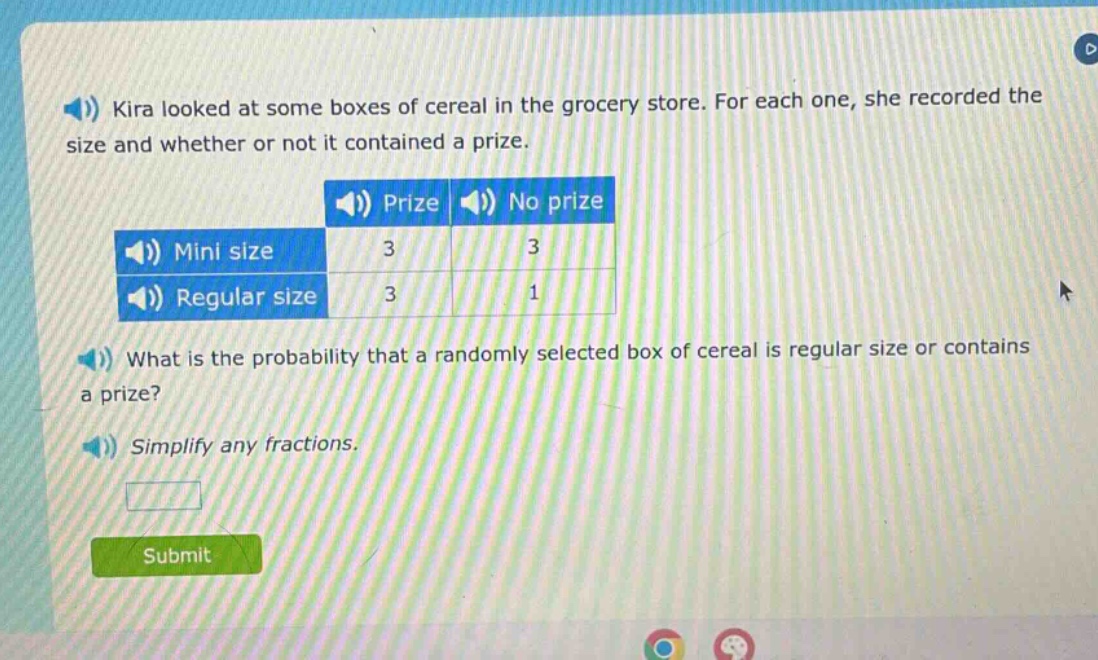
kira looked at some boxes of cereal in the grocery store. for each one, she recorded the size and whether or not it contained a prize.\n| | prize | no prize |\n|--|--|--|\n| mini size | 3 | 3 |\n| regular size | 3 | 1 |\nwhat is the probability that a randomly selected box of cereal is regular size or contains a prize?\nsimplify any fractions.
Answer
Explanation:
Step1: Calculate total number of boxes
The total number of boxes is (3 + 3+3 + 1=10).
Step2: Calculate number of regular - size boxes
The number of regular - size boxes is (3 + 1 = 4).
Step3: Calculate number of boxes with a prize
The number of boxes with a prize is (3+3 = 6).
Step4: Calculate number of regular - size boxes with a prize
The number of regular - size boxes with a prize is (3).
Step5: Use the formula for (P(A\cup B))
The formula for (P(A\cup B)=P(A)+P(B)-P(A\cap B)). Here, (A) is the event of a box being regular - size and (B) is the event of a box having a prize. (P(A)=\frac{4}{10}), (P(B)=\frac{6}{10}), and (P(A\cap B)=\frac{3}{10}). Then (P(A\cup B)=\frac{4 + 6-3}{10}=\frac{7}{10}).
Answer:
(\frac{7}{10})