kiyo is creating a table using mosaic tiles chosen and placed randomly. she is picking tiles without…
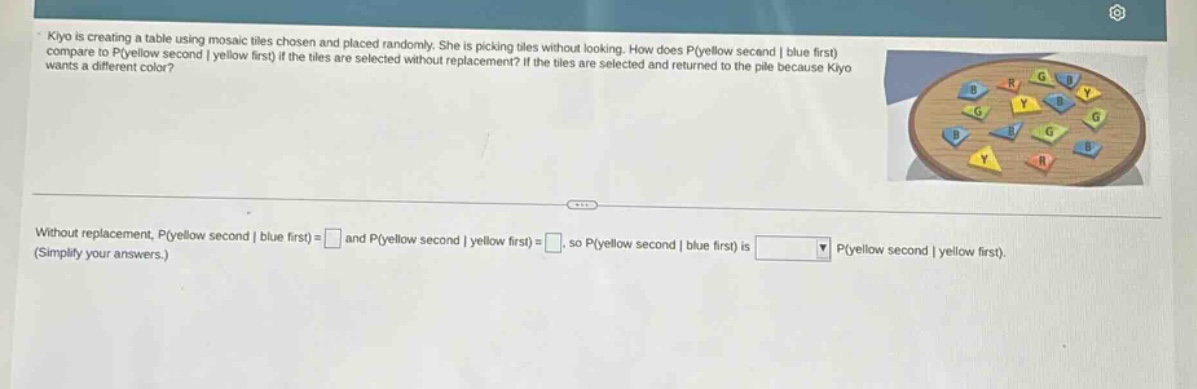
kiyo is creating a table using mosaic tiles chosen and placed randomly. she is picking tiles without looking. how does p(yellow second | blue first) compare to p(yellow second | yellow first) if the tiles are selected without replacement? if the tiles are selected and returned to the pile because kiyo wants a different color? without replacement, p(yellow second | blue first)= and p(yellow second | yellow first)=, so p(yellow second | blue first) is p(yellow second | yellow first). (simplify your answers.)
Answer
Explanation:
Step1: Contar el número de fichas
Supongamos que hay $n$ fichas en total. Contando en la imagen, $n = 15$.
Step2: Calcular $P(\text{yellow second}|\text{blue first})$ sin reemplazo
Hay 4 fichas azules y 3 fichas amarillas. Si la primera ficha es azul, quedan 14 fichas. Entonces $P(\text{yellow second}|\text{blue first})=\frac{3}{14}$.
Step3: Calcular $P(\text{yellow second}|\text{yellow first})$ sin reemplazo
Si la primera ficha es amarilla, quedan 2 fichas amarillas y 14 fichas en total. Entonces $P(\text{yellow second}|\text{yellow first})=\frac{2}{14}=\frac{1}{7}$.
Step4: Comparar las probabilidades
$\frac{3}{14}>\frac{1}{7}$ (ya que $\frac{1}{7}=\frac{2}{14}$).
Answer:
$P(\text{yellow second}|\text{blue first})=\frac{3}{14}$ and $P(\text{yellow second}|\text{yellow first})=\frac{1}{7}$, so $P(\text{yellow second}|\text{blue first})$ is greater than $P(\text{yellow second}|\text{yellow first})$.