a label on a cereal box states that there is 1 of 6 different prizes inside each box. a student is…
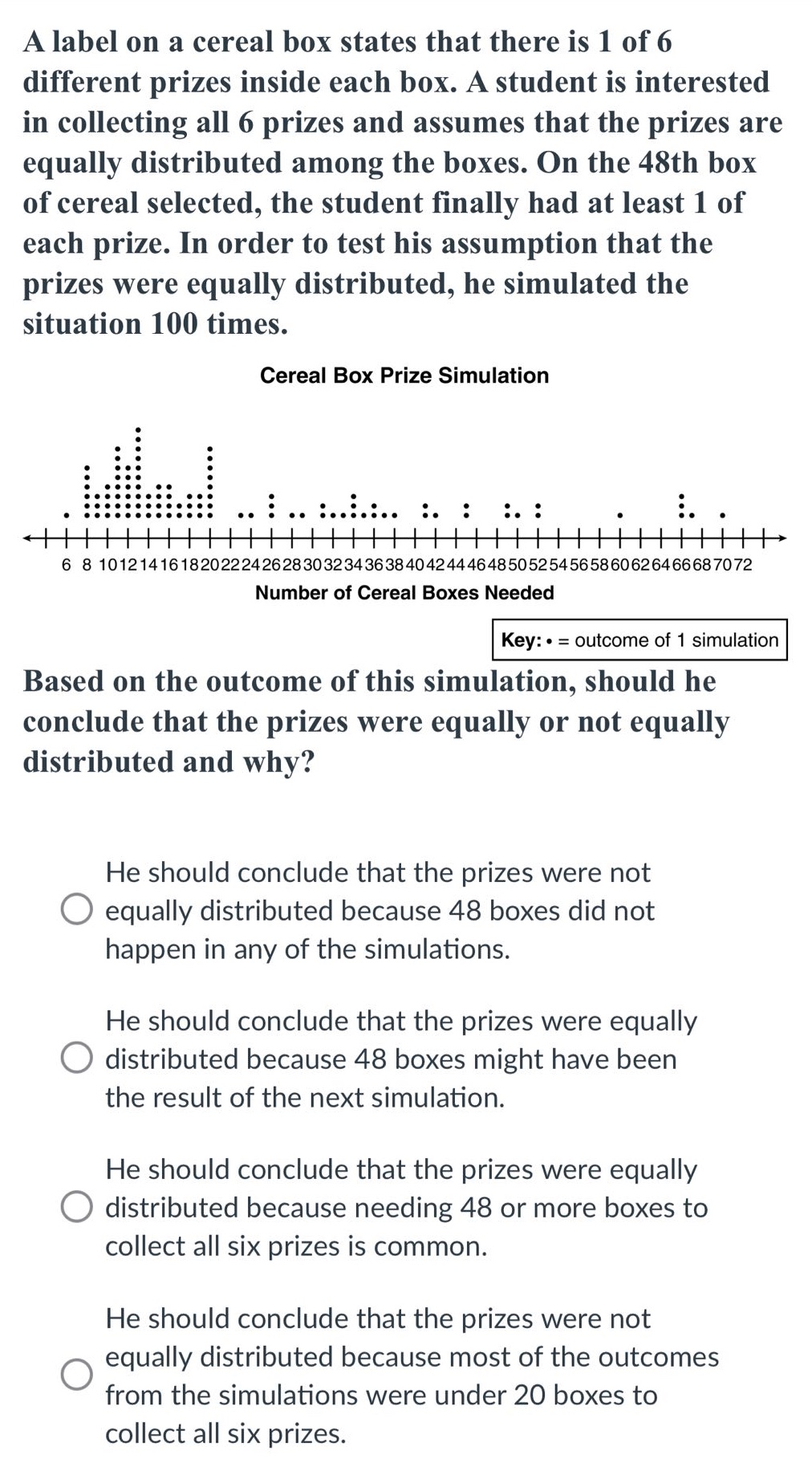
a label on a cereal box states that there is 1 of 6 different prizes inside each box. a student is interested in collecting all 6 prizes and assumes that the prizes are equally distributed among the boxes. on the 48th box of cereal selected, the student finally had at least 1 of each prize. in order to test his assumption that the prizes were equally distributed, he simulated the situation 100 times.\ncereal box prize simulation\nkey: • = outcome of 1 simulation\nbased on the outcome of this simulation, should he conclude that the prizes were equally or not equally distributed and why?\nhe should conclude that the prizes were not equally distributed because 48 boxes did not happen in any of the simulations.\nhe should conclude that the prizes were equally distributed because 48 boxes might have been the result of the next simulation.\nhe should conclude that the prizes were equally distributed because needing 48 or more boxes to collect all six prizes is common.\nhe should conclude that the prizes were not equally distributed because most of the outcomes from the simulations were under 20 boxes to collect all six prizes.
Answer
Brief Explanations:
The simulation shows that most outcomes required under 20 boxes to collect all six prizes. The student needed 48 boxes in reality. This large - scale difference in the number of boxes needed suggests that the actual situation is inconsistent with the assumption of equal distribution.
Answer:
He should conclude that the prizes were not equally distributed because most of the outcomes from the simulations were under 20 boxes to collect all six prizes.