last year, raul estimated that he would need 480 night lights, but he sold 420 night lights. this year, he…
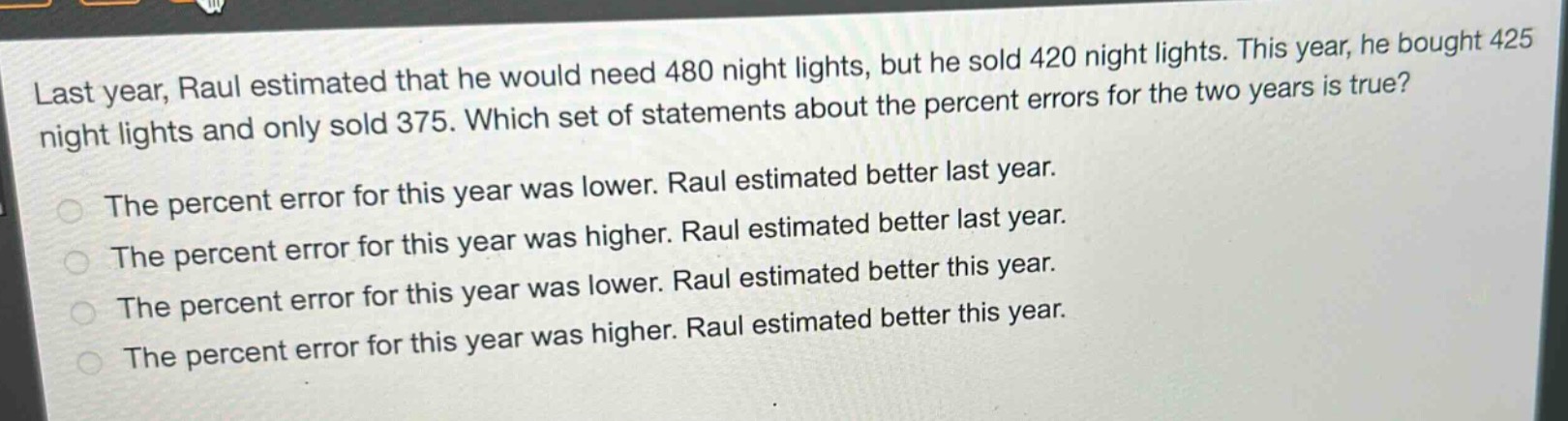
last year, raul estimated that he would need 480 night lights, but he sold 420 night lights. this year, he bought 425 night lights and only sold 375. which set of statements about the percent errors for the two years is true? the percent error for this year was lower. raul estimated better last year. the percent error for this year was higher. raul estimated better last year. the percent error for this year was lower. raul estimated better this year. the percent error for this year was higher. raul estimated better this year.
Answer
Explanation:
Step1: Recall percent - error formula
Percent error = $\left|\frac{\text{Estimated value}-\text{Actual value}}{\text{Actual value}}\right|\times100%$
Step2: Calculate percent error for last year
Last year, estimated value $E_1 = 480$, actual value $A_1=420$. Percent error $P_1=\left|\frac{480 - 420}{420}\right|\times100%=\left|\frac{60}{420}\right|\times100%\approx14.29%$
Step3: Calculate percent error for this year
This year, estimated value $E_2 = 425$, actual value $A_2 = 375$. Percent error $P_2=\left|\frac{425-375}{375}\right|\times100%=\left|\frac{50}{375}\right|\times100%\approx13.33%$
Step4: Compare percent errors and make a conclusion
Since $P_2\approx13.33%<P_1\approx14.29%$, the percent - error for this year was lower. And a lower percent - error means a better estimate, so Raul estimated better this year.
Answer:
The percent error for this year was lower. Raul estimated better this year.