this is a lesson 17 problem. we will test the following hypotheses: $h_0: p_{baltimore}=p_{philadelphia}$…
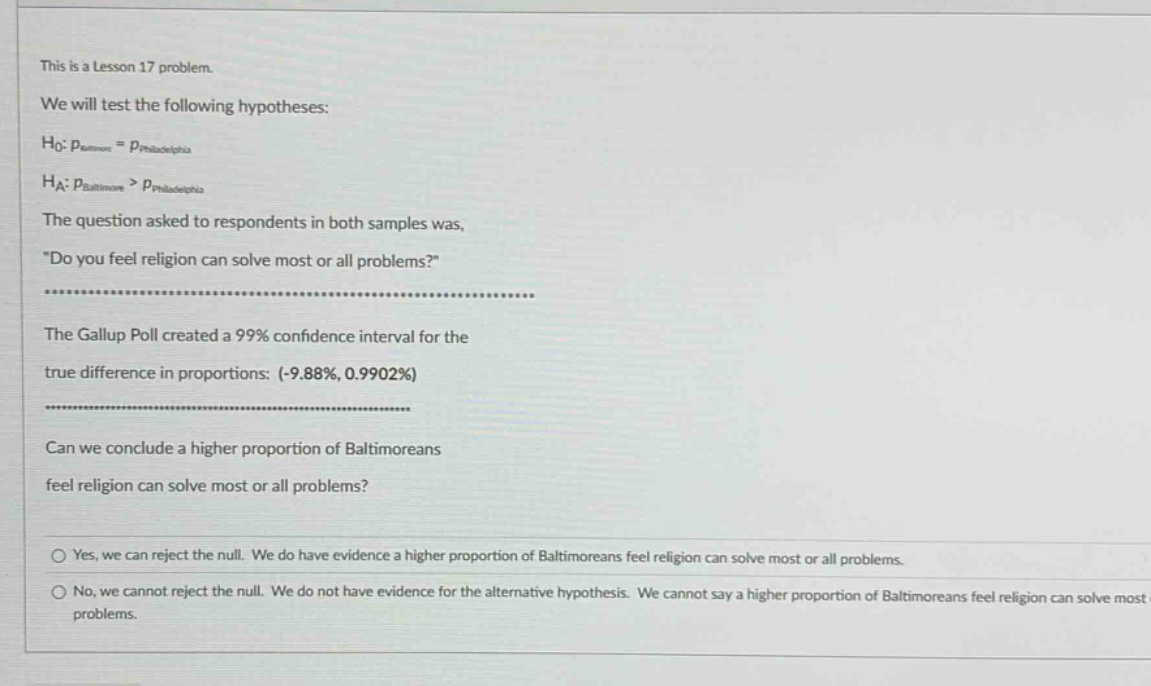
this is a lesson 17 problem. we will test the following hypotheses: $h_0: p_{baltimore}=p_{philadelphia}$ $h_a: p_{baltimore}>p_{philadelphia}$ the question asked to respondents in both samples was, \do you feel religion can solve most or all problems?\ the gallup poll created a 99% confidence interval for the true difference in proportions: (-9.88%, 0.9902%) can we conclude a higher proportion of baltimoreans feel religion can solve most or all problems? yes, we can reject the null. we do have evidence a higher proportion of baltimoreans feel religion can solve most or all problems. no, we cannot reject the null. we do not have evidence for the alternative hypothesis. we cannot say a higher proportion of baltimoreans feel religion can solve most problems.
Answer
Explanation:
Step1: Analyze confidence - interval
The 99% confidence interval for the true difference in proportions (p_{Baltimore}-p_{Philadelphia}) is ((- 9.88%,0.9902%)).
Step2: Check null - hypothesis decision
If the confidence interval contains 0, we cannot reject the null hypothesis (H_0:p_{Baltimore}=p_{Philadelphia}). Since (0) is within the interval ((-9.88%,0.9902%)), we cannot reject the null hypothesis.
Answer:
No, we cannot reject the null. We do not have evidence for the alternative hypothesis. We cannot say a higher proportion of Baltimoreans feel religion can solve most problems.