let k be the number of successes (green) when the spinner is spun 4 times. the graph shows the distribution…
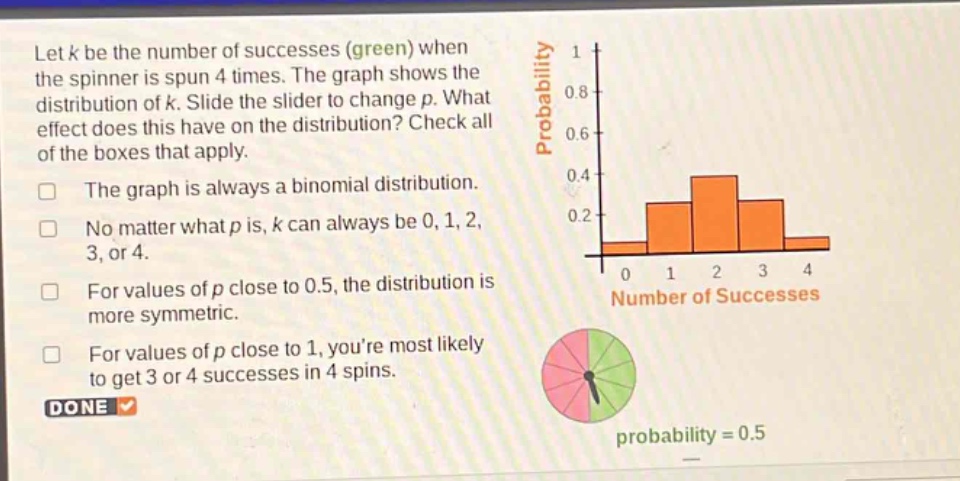
let k be the number of successes (green) when the spinner is spun 4 times. the graph shows the distribution of k. slide the slider to change p. what effect does this have on the distribution? check all of the boxes that apply. the graph is always a binomial distribution. no matter what p is, k can always be 0, 1, 2, 3, or 4. for values of p close to 0.5, the distribution is more symmetric. for values of p close to 1, youre most likely to get 3 or 4 successes in 4 spins. done
Answer
Brief Explanations:
- The experiment of spinning the spinner a fixed number of times (4 times here) with two - possible outcomes (success - green and non - success) and a constant probability of success $p$ for each spin is a binomial experiment, so the graph is always a binomial distribution.
- Since $k$ represents the number of successes in 4 spins, the possible values of $k$ range from 0 (no successes) to 4 (all successes).
- In a binomial distribution $B(n,p)$ with $n$ trials, when $p = 0.5$, the distribution is symmetric. As $p$ gets closer to 0.5, the symmetry becomes more pronounced.
- When $p$ is close to 1, the probability of success in each trial is high. So, in 4 trials, we are more likely to have a large number of successes (3 or 4).
Answer:
The graph is always a binomial distribution. No matter what $p$ is, $k$ can always be 0, 1, 2, 3, or 4. For values of $p$ close to 0.5, the distribution is more symmetric. For values of $p$ close to 1, you're most likely to get 3 or 4 successes in 4 spins.