let p represent the statement \the car is blue\ and q represent the statement \the car is spacious.\ what is…
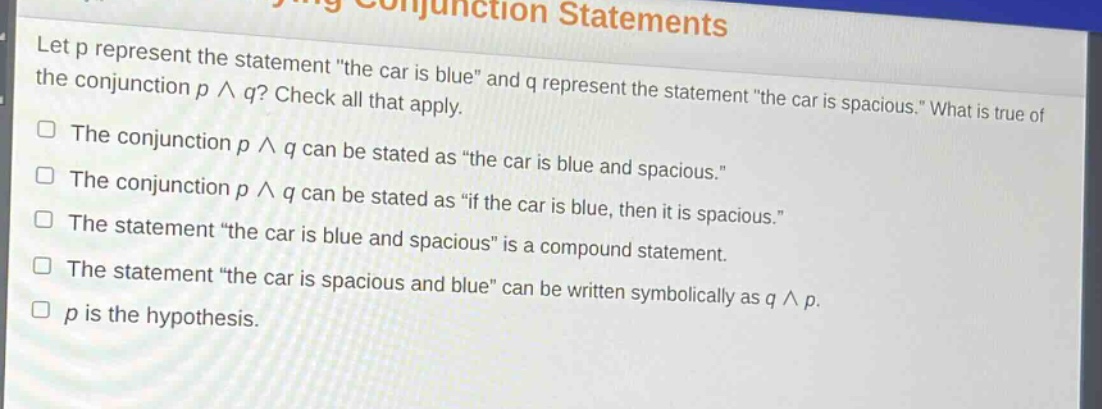
let p represent the statement \the car is blue\ and q represent the statement \the car is spacious.\ what is true of the conjunction p ∧ q? check all that apply.\nthe conjunction p ∧ q can be stated as \the car is blue and spacious.\\nthe conjunction p ∧ q can be stated as \if the car is blue, then it is spacious.\\nthe statement \the car is blue and spacious\ is a compound statement.\nthe statement \the car is spacious and blue\ can be written symbolically as q ∧ p.\np is the hypothesis.
Answer
Brief Explanations:
- In logic, the conjunction $p\land q$ means both $p$ and $q$ are true simultaneously, so it can be stated as "the car is blue and spacious".
- "If the car is blue, then it is spacious" is an implication ($p\rightarrow q$), not a conjunction.
- "The car is blue and spacious" is a compound statement as it combines two simple statements $p$ and $q$.
- Commutativity holds for conjunction, so "the car is spacious and blue" is $q\land p$.
- In a conjunction, there is no concept of hypothesis as in a conditional statement.
Answer:
- The conjunction $p\land q$ can be stated as "the car is blue and spacious."
- The statement "the car is blue and spacious" is a compound statement.
- The statement "the car is spacious and blue" can be written symbolically as $q\land p$.