lighter cars are more fuel - efficient than heavier cars. an environmentalist would like to estimate the…
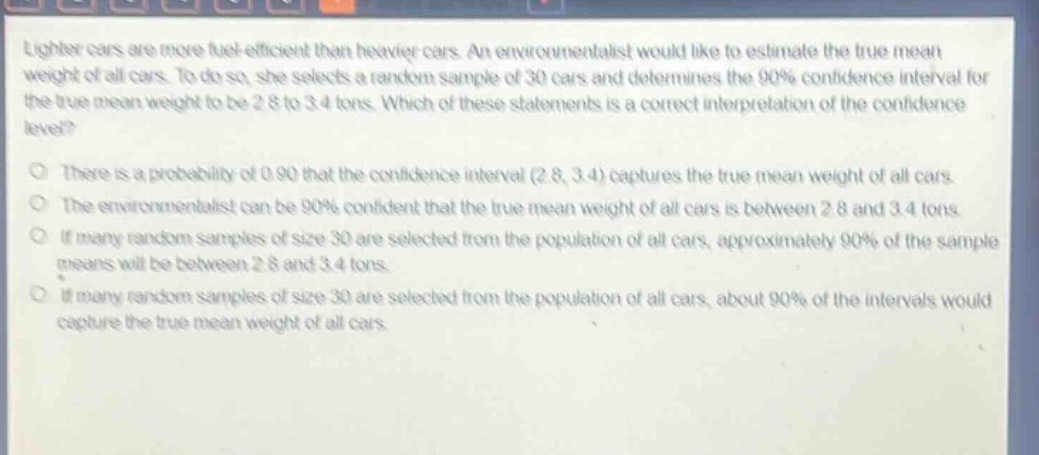
lighter cars are more fuel - efficient than heavier cars. an environmentalist would like to estimate the true mean weight of all cars. to do so, she selects a random sample of 30 cars and determines the 90% confidence interval for the true mean weight to be 2.8 to 3.4 tons. which of these statements is a correct interpretation of the confidence level?\nthere is a probability of 0.90 that the confidence interval (2.8, 3.4) captures the true mean weight of all cars.\nthe environmentalist can be 90% confident that the true mean weight of all cars is between 2.8 and 3.4 tons.\nif many random samples of size 30 are selected from the population of all cars, approximately 90% of the sample means will be between 2.8 and 3.4 tons.\nif many random samples of size 30 are selected from the population of all cars, about 90% of the intervals would capture the true mean weight of all cars.
Answer
Brief Explanations:
The confidence level of a confidence - interval means that if we take many random samples of the same size from the population, about that percentage (in this case 90%) of the constructed intervals will contain the true population parameter (the true mean weight of all cars here). The first option misinterprets the probability as being about the specific interval capturing the true mean. The second option makes it seem like the true mean is definitely in the interval with a 90% certainty, which is not correct. The third option is about sample means being in the interval, not about the intervals capturing the true population mean.
Answer:
If many random samples of size 30 are selected from the population of all cars, about 90% of the intervals would capture the true mean weight of all cars.