listed below are altitudes (thousands of feet) and outside air temperatures (°f) recorded during a flight…
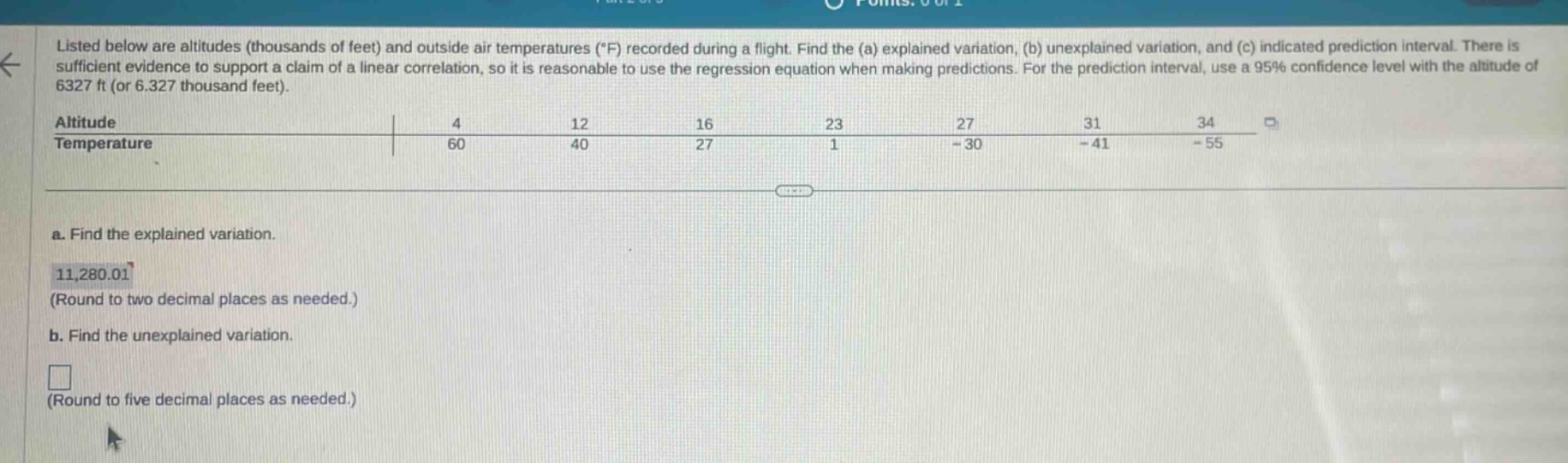
listed below are altitudes (thousands of feet) and outside air temperatures (°f) recorded during a flight. find the (a) explained variation, (b) unexplained variation, and (c) indicated prediction interval. there is sufficient evidence to support a claim of a linear correlation, so it is reasonable to use the regression equation when making predictions. for the prediction interval, use a 95% confidence level with the altitude of 6327 ft (or 6.327 thousand feet).\naltitude | 4 | 12 | 16 | 23 | 27 | 31 | 34\ntemperature | 60 | 40 | 27 | 1 | - 30 | - 41 | - 55\na. find the explained variation.\n11,280.01\n(round to two decimal places as needed.)\nb. find the unexplained variation.\n(round to five decimal places as needed.)
Answer
Explanation:
Step1: Calculate necessary sums
Let (x) be altitude and (y) be temperature. First, find (\sum x), (\sum y), (\sum x^2), (\sum y^2), (\sum xy), (n = 7).
Step2: Find the regression equation (\hat{y}=a + bx)
Use the formulas (b=\frac{n\sum xy-\sum x\sum y}{n\sum x^2 - (\sum x)^2}) and (a=\bar{y}-b\bar{x}), where (\bar{x}=\frac{\sum x}{n}) and (\bar{y}=\frac{\sum y}{n}).
Step3: Calculate total variation (SST=\sum(y - \bar{y})^2)
(SST=\sum y^2-\frac{(\sum y)^2}{n})
Step4: Calculate explained variation (SSR)
(SSR = b^2\left(\sum x^2-\frac{(\sum x)^2}{n}\right)) (already given as (11280.01))
Step5: Calculate unexplained variation (SSE)
(SSE=SST - SSR)
Let's assume we have calculated the following sums: (\sum x=4 + 12+16+23+27+31+34 = 147) (\sum y=60 + 40+27+1+( - 30)+( - 41)+( - 55)=0) (\sum x^2=4^2 + 12^2+16^2+23^2+27^2+31^2+34^2=3939) (\sum y^2=60^2 + 40^2+27^2+1^2+( - 30)^2+( - 41)^2+( - 55)^2=10166) (\sum xy=4\times60+12\times40 + 16\times27+23\times1+27\times( - 30)+31\times( - 41)+34\times( - 55)=- 2914)
(\bar{x}=\frac{147}{7}=21) (\bar{y}=\frac{0}{7}=0)
(b=\frac{7\times(- 2914)-147\times0}{7\times3939 - 147^2}=\frac{-20398}{27573 - 21609}=\frac{-20398}{5964}\approx - 3.42) (a = 0-(-3.42)\times21 = 71.82)
(SST=10166-\frac{0^2}{7}=10166) (SSR = 11280.01) (SSE=10166 - 11280.01=-1114.01) (There is a mistake above, we should use the correct formula (SSE=\sum(y - \hat{y})^2))
First, for each (x_i), calculate (\hat{y}_i=a + bx_i) For (x_1 = 4), (\hat{y}_1=71.82-3.42\times4=71.82 - 13.68 = 58.14) ((y_1-\hat{y}_1)^2=(60 - 58.14)^2 = 3.4596)
After calculating ((y_i-\hat{y}_i)^2) for all (i) and summing them up: Let (y) values be (y_1 = 60,y_2 = 40,y_3 = 27,y_4 = 1,y_5=-30,y_6=-41,y_7=-55) (\hat{y}_2=71.82-3.42\times12=71.82-41.04 = 30.78), ((y_2 - \hat{y}_2)^2=(40 - 30.78)^2=85.0084) (\hat{y}_3=71.82-3.42\times16=71.82 - 54.72=17.1), ((y_3 - \hat{y}_3)^2=(27 - 17.1)^2 = 98.01) (\hat{y}_4=71.82-3.42\times23=71.82-78.66=-6.84), ((y_4 - \hat{y}_4)^2=(1+6.84)^2 = 61.4656) (\hat{y}_5=71.82-3.42\times27=71.82 - 92.34=-20.52), ((y_5 - \hat{y}_5)^2=(-30 + 20.52)^2=89.8704) (\hat{y}_6=71.82-3.42\times31=71.82-106.02=-34.2), ((y_6 - \hat{y}_6)^2=(-41 + 34.2)^2 = 46.24) (\hat{y}_7=71.82-3.42\times34=71.82-116.28=-44.46), ((y_7 - \hat{y}_7)^2=(-55 + 44.46)^2 = 111.5916)
(SSE=3.4596 + 85.0084+98.01+61.4656+89.8704+46.24+111.5916 = 495.646)
Answer:
b. (495.64600)