liz buys a large bag of 400 jelly beans. her favorite flavor is lemon, and she wonders how many lemon jelly…
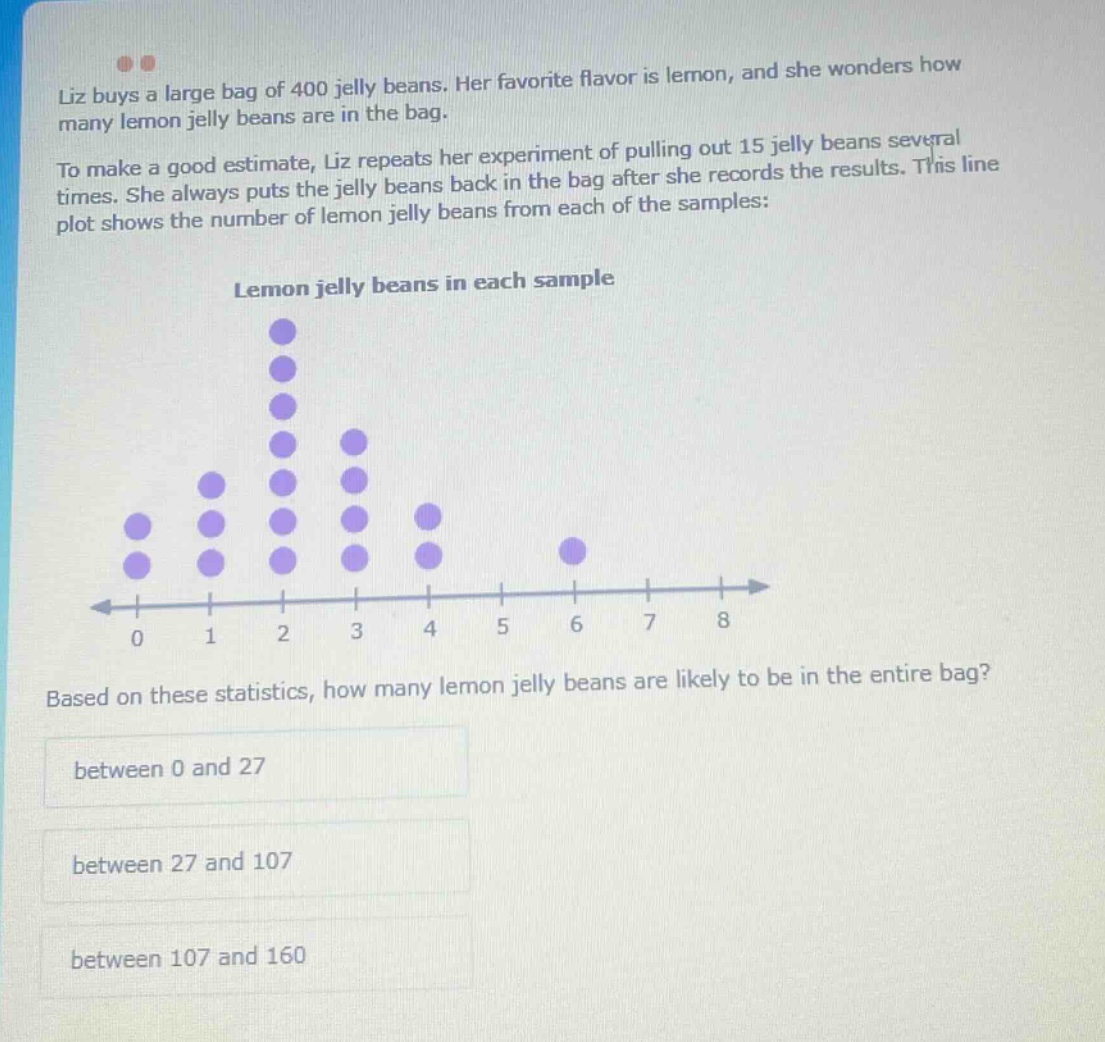
liz buys a large bag of 400 jelly beans. her favorite flavor is lemon, and she wonders how many lemon jelly beans are in the bag. to make a good estimate, liz repeats her experiment of pulling out 15 jelly beans several times. she always puts the jelly beans back in the bag after she records the results. this line plot shows the number of lemon jelly beans from each of the samples: lemon jelly beans in each sample based on these statistics, how many lemon jelly beans are likely to be in the entire bag? between 0 and 27 between 27 and 107 between 107 and 160
Answer
Answer:
between 27 and 107
Explanation:
Step1: Count sample points
There are 15 sample - points (dots on the line - plot).
Step2: Calculate total lemon jelly beans in samples
Counting the dots, we find the number of lemon jelly beans in the 15 samples. Let's assume the sum of lemon jelly beans in the 15 samples of size 15 each is (S). By counting, we have: (2\times0 + 3\times1+7\times2 + 3\times3+1\times6=0 + 3+14 + 9+6=32).
Step3: Calculate proportion
The proportion of lemon jelly beans in the samples is (p=\frac{32}{15\times15}=\frac{32}{225}).
Step4: Estimate for the whole bag
The estimated number of lemon jelly beans in the bag of 400 jelly beans is (N = p\times400=\frac{32}{225}\times400=\frac{12800}{225}\approx56.9), which is between 27 and 107.