a local athletic facility offers a four - week training course, hoping to increase athletes running speeds…
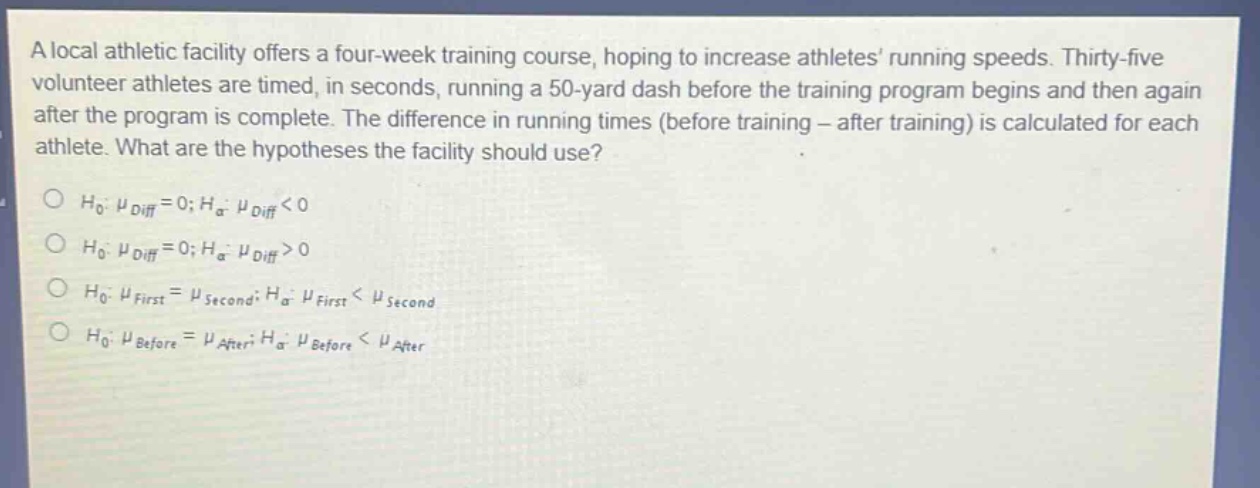
a local athletic facility offers a four - week training course, hoping to increase athletes running speeds. thirty - five volunteer athletes are timed, in seconds, running a 50 - yard dash before the training program begins and then again after the program is complete. the difference in running times (before training - after training) is calculated for each athlete. what are the hypotheses the facility should use?\n$h_0: mu_{diff}=0; h_a: mu_{diff}<0$\n$h_0: mu_{diff}=0; h_a: mu_{diff}>0$\n$h_0: mu_{first}=mu_{second}; h_a: mu_{first}<mu_{second}$\n$h_0: mu_{before}=mu_{after}; h_a: mu_{before}<mu_{after}$
Answer
Brief Explanations:
The null hypothesis ($H_0$) is usually a statement of no - effect. Here, no effect means no difference in running times before and after training, so $\mu_{Diff}=0$. The alternative hypothesis ($H_a$) is what we are testing for. Since the facility hopes to increase running speeds (which means the running time after training is less than before), the difference (before - after) should be positive. So $H_a:\mu_{Diff}>0$.
Answer:
$H_0:\mu_{Diff}=0; H_a:\mu_{Diff}>0$