a local athletic facility offers a four - week training course, hoping to increase athletes running speeds…
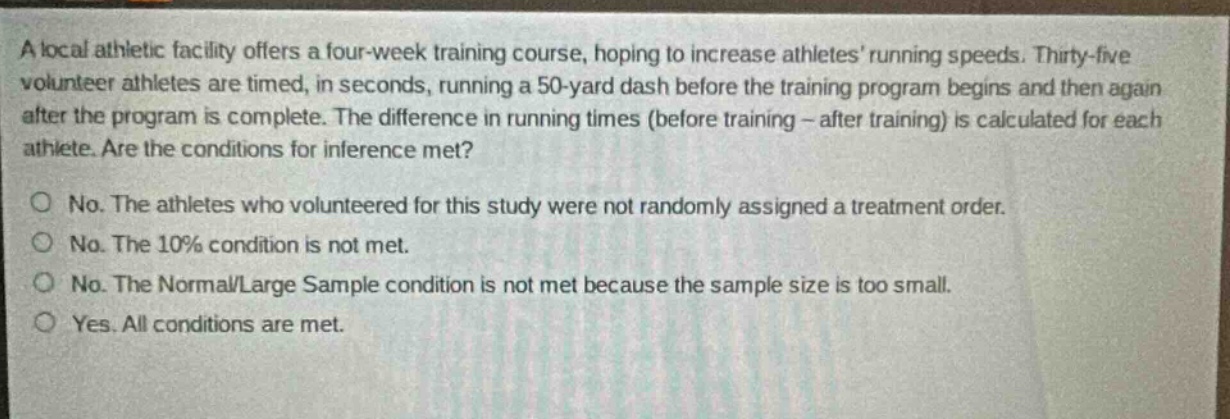
a local athletic facility offers a four - week training course, hoping to increase athletes running speeds. thirty - five volunteer athletes are timed, in seconds, running a 50 - yard dash before the training program begins and then again after the program is complete. the difference in running times (before training - after training) is calculated for each athlete. are the conditions for inference met?\no no. the athletes who volunteered for this study were not randomly assigned a treatment order.\no no. the 10% condition is not met.\no no. the normal/large sample condition is not met because the sample size is too small.\no yes. all conditions are met.
Answer
Brief Explanations:
For inference in a paired - samples situation like this (pre - and post - training times), we need to consider randomness, 10% condition, and normal/large sample condition. The athletes are volunteers and not randomly assigned a treatment order (pre - then post or post - then pre). Random assignment helps to control for confounding variables. Since they are not randomly assigned, the conditions for inference are not met.
Answer:
No. The athletes who volunteered for this study were not randomly assigned a treatment order.