a lock is opened using a sequence of three numbers. the numbers range from 0 to 39, inclusive, and cannot be…
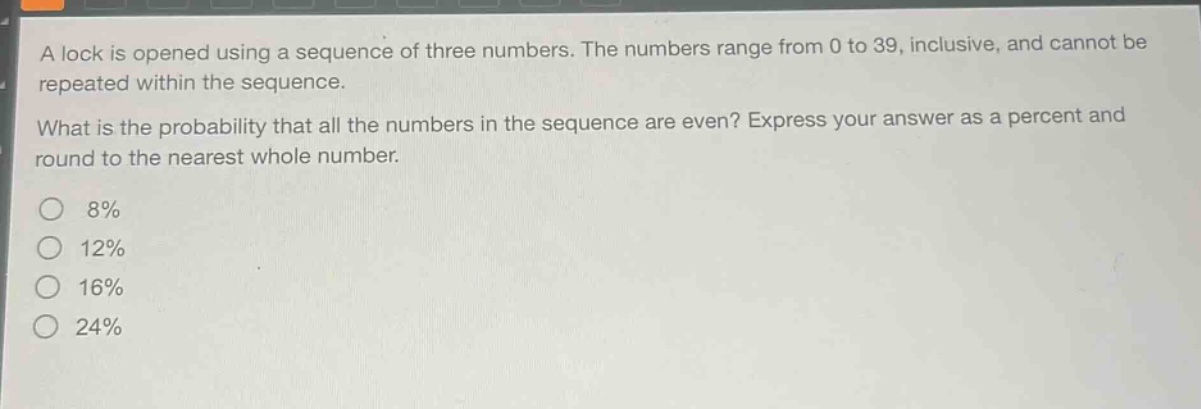
a lock is opened using a sequence of three numbers. the numbers range from 0 to 39, inclusive, and cannot be repeated within the sequence.\nwhat is the probability that all the numbers in the sequence are even? express your answer as a percent and round to the nearest whole number.\n8%\n12%\n16%\n24%
Answer
Explanation:
Step1: Calculate total number of combinations
The total number of ways to choose 3 non - repeated numbers from 40 numbers (0 to 39) is given by the permutation formula $P(n,r)=\frac{n!}{(n - r)!}$, where $n = 40$ and $r=3$. So $P(40,3)=\frac{40!}{(40 - 3)!}=\frac{40!}{37!}=40\times39\times38=59280$.
Step2: Calculate number of combinations with all even numbers
There are 20 even numbers from 0 to 39. The number of ways to choose 3 non - repeated even numbers is $P(20,3)=\frac{20!}{(20 - 3)!}=\frac{20!}{17!}=20\times19\times18 = 6840$.
Step3: Calculate the probability
The probability $P$ that all the numbers in the sequence are even is $P=\frac{\text{Number of favorable outcomes}}{\text{Total number of outcomes}}=\frac{6840}{59280}\approx0.1154$.
Step4: Convert to percentage and round
To convert to a percentage, we multiply by 100: $0.1154\times100 = 11.54%$. Rounding to the nearest whole number gives 12%.
Answer:
12%