lorena has a jar of coins. she chooses a coin at random, notes what type of coin it is, and returns it to…
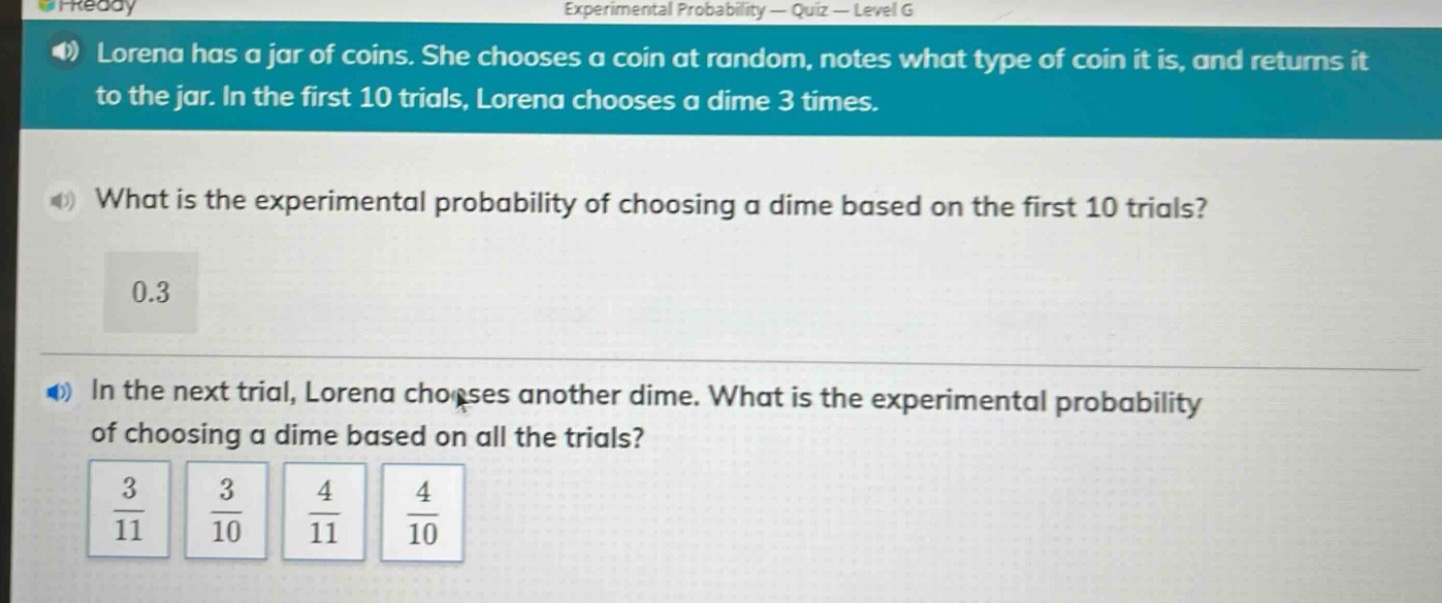
lorena has a jar of coins. she chooses a coin at random, notes what type of coin it is, and returns it to the jar. in the first 10 trials, lorena chooses a dime 3 times.\nwhat is the experimental probability of choosing a dime based on the first 10 trials?\n0.3\nin the next trial, lorena chooses another dime. what is the experimental probability of choosing a dime based on all the trials?\n$\frac{3}{11}$ $\frac{3}{10}$ $\frac{4}{11}$ $\frac{4}{10}$
Answer
Explanation:
Step1: Recall experimental - probability formula
Experimental probability (P=\frac{\text{Number of favorable outcomes}}{\text{Total number of trials}})
Step2: Calculate for the first 10 trials
In the first 10 trials, the number of times a dime is chosen (favorable outcomes) is 3, and the total number of trials is 10. So the experimental probability (P_1=\frac{3}{10}=0.3)
Step3: Calculate for 11 trials
After the 11 - th trial, the number of times a dime is chosen (favorable outcomes) is (3 + 1=4), and the total number of trials is (10+1 = 11). So the experimental probability (P_2=\frac{4}{11})
Answer:
The experimental probability for the first 10 trials is 0.3. The experimental probability for all 11 trials is (\frac{4}{11})