4. luis has two number cubes. the faces of each number cube are numbered 1 to 6. luis rolled the number…
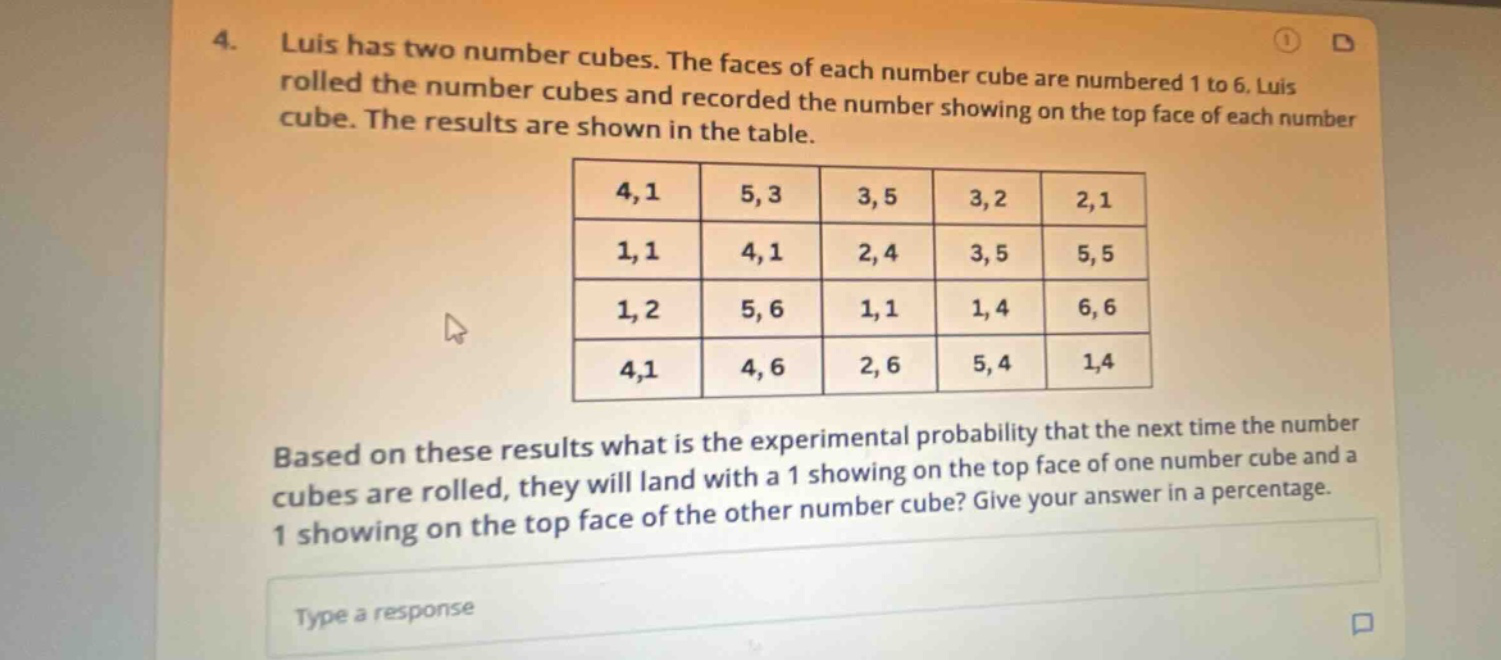
4. luis has two number cubes. the faces of each number cube are numbered 1 to 6. luis rolled the number cubes and recorded the number showing on the top face of each number cube. the results are shown in the table. 4,1 5,3 3,5 3,2 2,1 1,1 4,1 2,4 3,5 5,5 1,2 5,6 1,1 1,4 6,6 4,1 4,6 2,6 5,4 1,4 based on these results what is the experimental probability that the next time the number cubes are rolled, they will land with a 1 showing on the top face of one number cube and a 1 showing on the top face of the other number cube? give your answer in a percentage. type a response
Answer
Answer:
25%
Explanation:
Step1: Count total rolls
There are 20 pairs of rolls.
Step2: Count favorable outcomes
The pairs with at - least one 1 are: (4,1), (5,3), (3,5), (3,2), (2,1), (1,1), (4,1), (2,4), (3,5), (5,5), (1,2), (5,6), (1,1), (1,4), (6,6), (4,1), (4,6), (2,6), (5,4), (1,4). The number of pairs with at - least one 1 is 5.
Step3: Calculate experimental probability
The experimental probability $P=\frac{\text{Number of favorable outcomes}}{\text{Total number of outcomes}}$. So $P = \frac{5}{20}=0.25$.
Step4: Convert to percentage
$0.25\times100% = 25%$.