lydia runs an experiment to determine if a coin is fair by counting the number of times a coin lands heads…
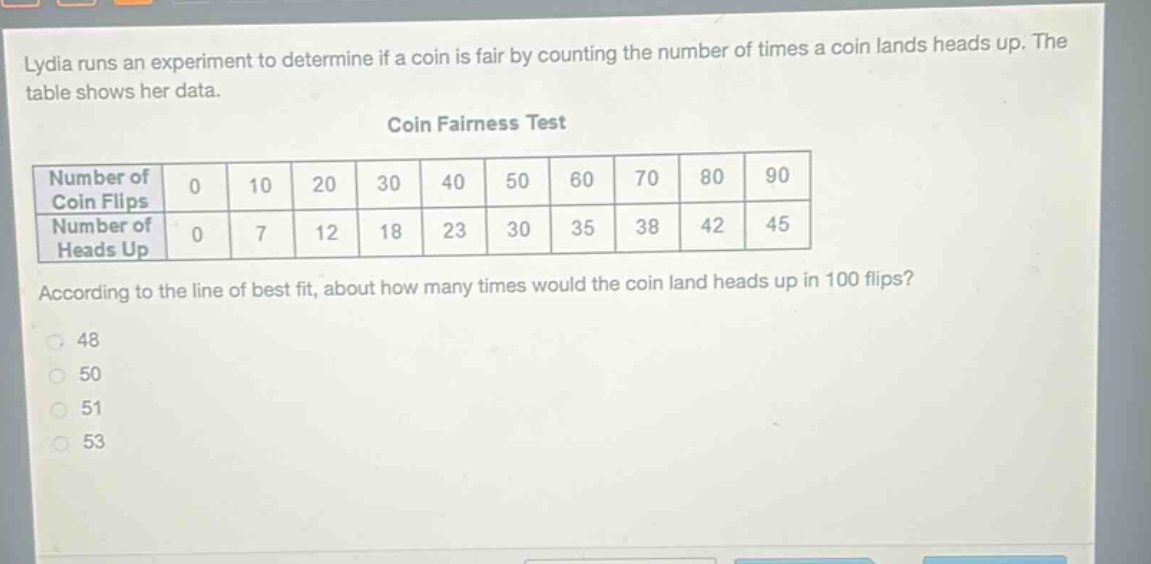
lydia runs an experiment to determine if a coin is fair by counting the number of times a coin lands heads up. the table shows her data.\ncoin fairness test\n|number of coin flips|0|10|20|30|40|50|60|70|80|90|\n|number of heads up|0|7|12|18|23|30|35|38|42|45|\naccording to the line of best fit, about how many times would the coin land heads up in 100 flips?\n48\n50\n51\n53
Answer
Explanation:
Step1: Calculate the slope and y - intercept
We can use the linear regression formula. Let (x) be the number of coin flips and (y) be the number of heads - up. First, we find the means of (x) and (y). The (x) - values are (x_1 = 0,x_2 = 10,\cdots,x_{10}=90), and the (y) - values are (y_1 = 0,y_2 = 7,\cdots,y_{10}=45). The mean of (x), (\bar{x}=\frac{0 + 10+\cdots+90}{10}=\frac{(0 + 90)\times10\div2}{10}=45). The mean of (y), (\bar{y}=\frac{0 + 7+\cdots+45}{10}=\frac{(0 + 45)\times10\div2}{10}=22.5). The slope (m=\frac{\sum_{i = 1}^{n}(x_i-\bar{x})(y_i - \bar{y})}{\sum_{i = 1}^{n}(x_i-\bar{x})^2}). (\sum_{i = 1}^{10}(x_i-\bar{x})(y_i - \bar{y})=(0 - 45)(0 - 22.5)+(10 - 45)(7 - 22.5)+\cdots+(90 - 45)(45 - 22.5)) (=45\times22.5+( - 35)\times( - 15.5)+( - 25)\times( - 10.5)+( - 15)\times( - 4.5)+( - 5)\times0.5+5\times12.5+15\times16.5+25\times20.5+35\times24.5+45\times22.5) (=1012.5 + 542.5+262.5 + 67.5-2.5 + 62.5+247.5+512.5+857.5+1012.5) (=4575). (\sum_{i = 1}^{10}(x_i-\bar{x})^2=(0 - 45)^2+(10 - 45)^2+\cdots+(90 - 45)^2) (=45^2+35^2+25^2+15^2+5^2+5^2+15^2+25^2+35^2+45^2) (=2025+1225 + 625+225+25+25+225+625+1225+2025) (=8250). So, (m=\frac{4575}{8250}=0.55). The y - intercept (b=\bar{y}-m\bar{x}=22.5-0.55\times45=22.5 - 24.75=-2.25). The equation of the line of best - fit is (y = 0.55x-2.25).
Step2: Substitute (x = 100) into the equation
When (x = 100), (y=0.55\times100-2.25). (y = 55-2.25=52.75\approx53).
Answer:
53