lydia runs an experiment to determine if a coin is fair by counting the number of times a coin lands heads…
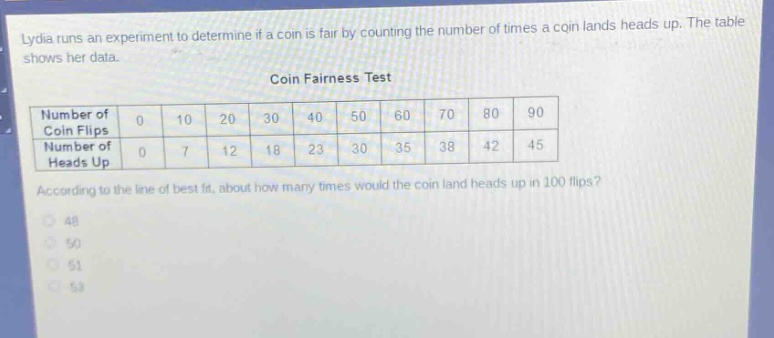
lydia runs an experiment to determine if a coin is fair by counting the number of times a coin lands heads up. the table shows her data.\ncoin fairness test\n|number of coin flips|0|10|20|30|40|50|60|70|80|90|\n|----|----|----|----|----|----|----|----|----|----|----|\n|number of heads up|0|7|12|18|23|30|35|38|42|45|\naccording to the line of best fit, about how many times would the coin land heads up in 100 flips?\n48\n50\n51\n53
Answer
Explanation:
Step1: Assume a linear relationship
We can assume the relationship between the number of coin - flips ($x$) and the number of heads ($y$) is linear. We can use the two - point form of a line $y - y_1=\frac{y_2 - y_1}{x_2 - x_1}(x - x_1)$. Let's take two points from the table, say $(10,7)$ and $(90,45)$.
Step2: Calculate the slope
The slope $m=\frac{y_2 - y_1}{x_2 - x_1}=\frac{45 - 7}{90 - 10}=\frac{38}{80}=0.475$.
Step3: Use the point - slope form with the point $(10,7)$
The equation of the line is $y - 7=0.475(x - 10)$. Expand it: $y-7 = 0.475x-4.75$, so $y=0.475x + 2.25$.
Step4: Substitute $x = 100$
When $x = 100$, $y=0.475\times100+2.25=47.5 + 2.25=49.75\approx50$.
Answer:
50