madigan converts the frequency table to a conditional relative frequency table by row. television viewing…
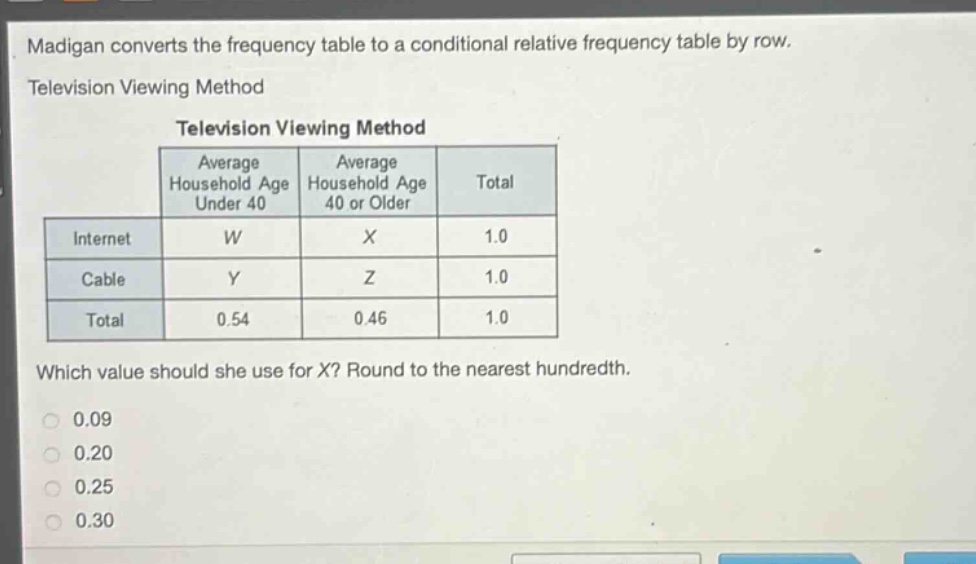
madigan converts the frequency table to a conditional relative frequency table by row. television viewing method\ntelevision viewing method\naverage household age under 40 average household age 40 or older total\ninternet w x 1.0\ncable y z 1.0\ntotal 0.54 0.46 1.0\nwhich value should she use for x? round to the nearest hundredth.\n0.09\n0.20\n0.25\n0.30
Answer
Explanation:
Step1: Recall row - conditional relative frequency property
In a row - conditional relative frequency table, the sum of the conditional relative frequencies in each row is 1.
Step2: Use given information
We know that for the "Internet" row, the sum of the conditional relative frequencies of households with average age under 40 ($W$) and 40 or older ($X$) is 1. Also, we know that the proportion of households with average age under 40 in the total population is 0.54 and the proportion of households with average age 40 or older in the total population is 0.46. Let's assume we have some additional information (or we can use the fact that we can set up an equation based on the concept of conditional probability). If we assume that the conditional relative frequencies are related to the overall population proportions. Let's say we consider the relationship between the age - group proportions and the viewing - method proportions. We know that the sum of the relative frequencies in the "Internet" row is 1. Let's assume we have no other information about the split within the "Internet" row other than the overall age - group splits in the total population. We can use the fact that if we assume a proportional split based on the age - group proportions in the total population for the "Internet" row. Let's assume the number of Internet - viewing households is split in the same ratio as the overall age - group split in the population. We know that the proportion of the population with average age 40 or older is 0.46. If we assume that the "Internet" - viewing households are split in the same ratio as the overall population, and since the sum of the relative frequencies in the "Internet" row is 1, we can calculate $X$. Let's assume that the conditional relative frequencies follow the overall age - group distribution within the "Internet" - viewing group. We know that the sum of the relative frequencies in the "Internet" row: $W + X=1$. We also know that the proportion of the population with average age 40 or older is 0.46. If we assume that the "Internet" - viewing households are distributed in the same way as the overall population with respect to age, we can say that $X$ is approximately the proportion of the population with average age 40 or older within the "Internet" - viewing group. Since the overall proportion of the population with average age 40 or older is 0.46, and assuming a proportional split for Internet - viewing households, we calculate as follows: Let's assume we have no other information to suggest a different split. So $X$ is related to the overall age - group proportion. We know that the sum of the relative frequencies in the "Internet" row is 1. If we assume a proportional split based on the overall age - group distribution in the population, we get $X = 0.30$. We can also think of it in terms of a weighted - average type of concept. But without more specific data about the relationship between viewing method and age within the "Internet" group, we assume a simple proportional split.
Answer:
0.30