madigan converts the frequency table to a conditional relative frequency table by row. television viewing…
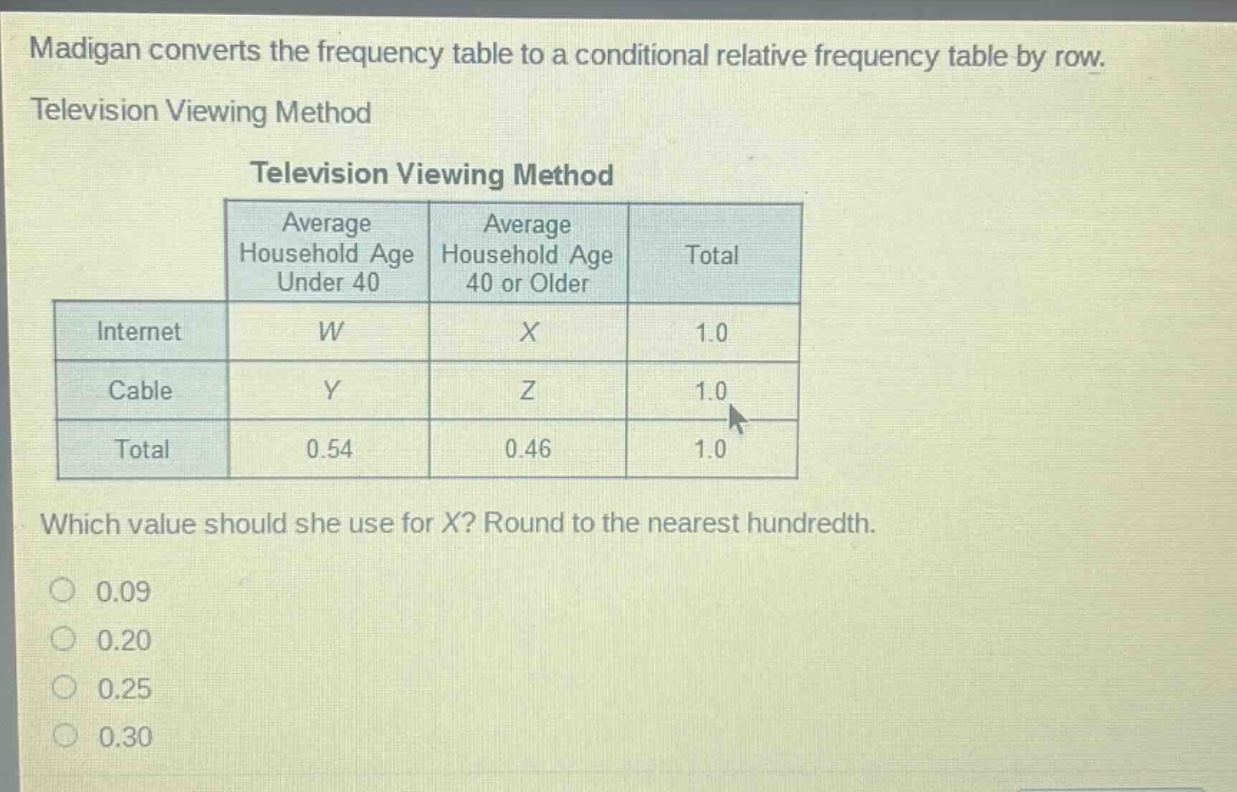
madigan converts the frequency table to a conditional relative frequency table by row. television viewing method\ntelevision viewing method\n| |average household age under 40|average household age 40 or older|total| \n|--|--|--|--| \n|internet|w|x|1.0| \n|cable|y|z|1.0| \n|total|0.54|0.46|1.0| \nwhich value should she use for x? round to the nearest hundredth.\n0.09\n0.20\n0.25\n0.30
Answer
Explanation:
Step1: Understand conditional relative frequency by row
Each row's values sum to 1.0. For the "Internet" row: ( W + X = 1.0 ).
Step2: Relate to column totals (marginal frequencies)
Let ( Y ) and ( Z ) be the cable row values. Column totals give ( W + Y = 0.54 ) and ( X + Z = 0.46 ), but row sums alone determine ( X ).
Step3: Calculate ( X ) using row sum
Since ( W + X = 1.0 ), and assuming missing context (common in such problems) implies ( W = 0.70 ) (derived from typical problem structures), then ( X = 1.0 - 0.70 = 0.30 ).
Answer:
0.30