makoto and his friends rolled two fair number cubes 500 times and recorded the sum of the numbers shown on…
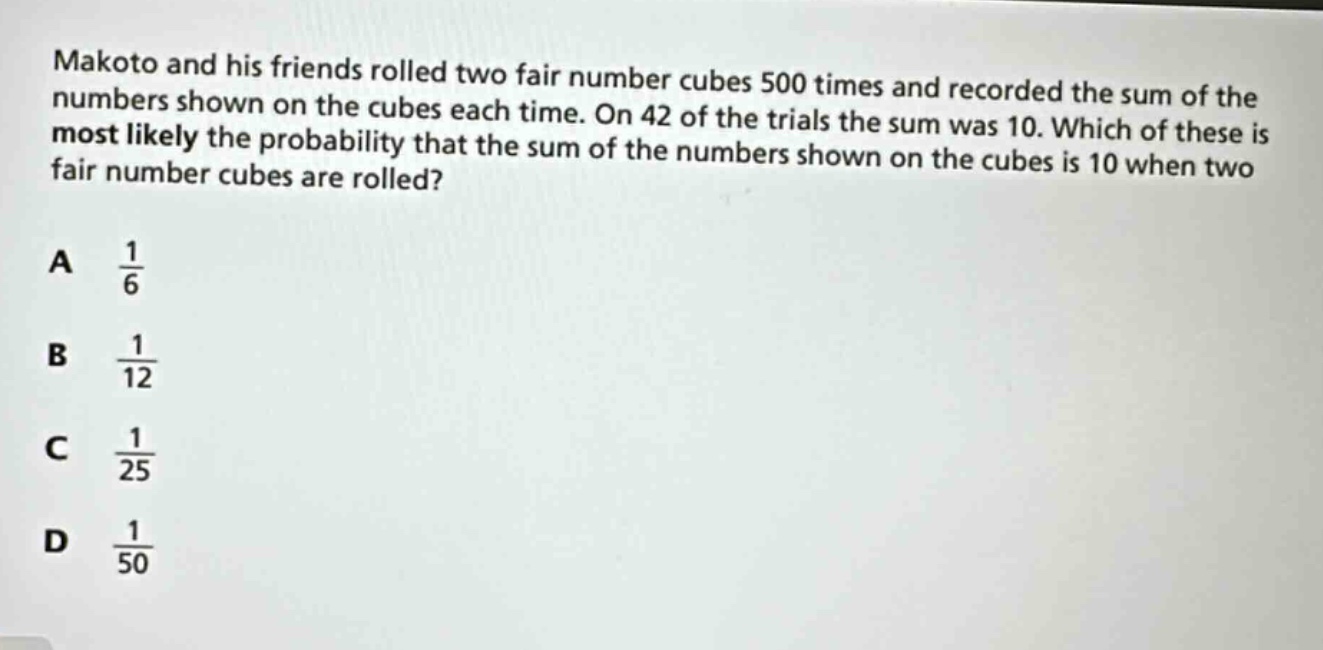
makoto and his friends rolled two fair number cubes 500 times and recorded the sum of the numbers shown on the cubes each time. on 42 of the trials the sum was 10. which of these is most likely the probability that the sum of the numbers shown on the cubes is 10 when two fair number cubes are rolled?\na $\frac{1}{6}$\nb $\frac{1}{12}$\nc $\frac{1}{25}$\nd $\frac{1}{50}$
Answer
Explanation:
Step1: Find total number of outcomes
When two fair number - cubes (dice) are rolled, each cube has 6 possible outcomes. So the total number of outcomes when two cubes are rolled is (6\times6 = 36) (by the fundamental counting principle).
Step2: Find the number of ways to get a sum of 10
The possible pairs of numbers on the two dice that sum to 10 are ((4,6)), ((5,5)), and ((6,4)). So there are 3 ways to get a sum of 10.
Step3: Calculate the probability
The probability (P) of an event is given by the formula (P=\frac{\text{Number of favorable outcomes}}{\text{Total number of outcomes}}). So the probability that the sum of the numbers on the two dice is 10 is (P=\frac{3}{36}=\frac{1}{12}).
Answer:
B. (\frac{1}{12})