margot is studying the yield of bushels of wheat in comparison to the amount of rainfall, in inches, that…
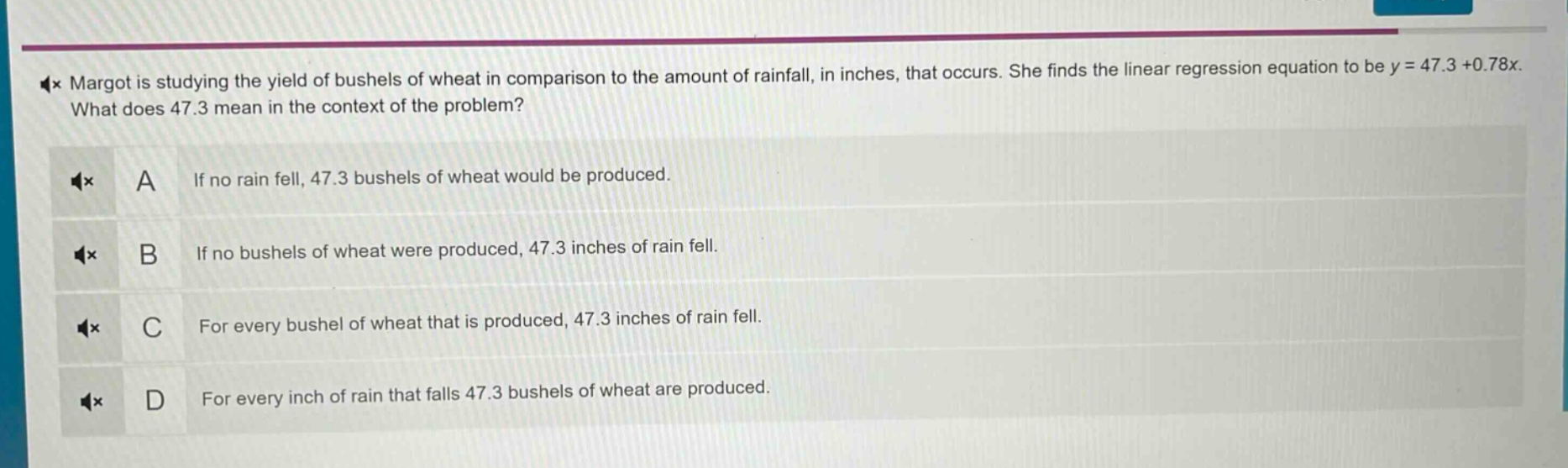
margot is studying the yield of bushels of wheat in comparison to the amount of rainfall, in inches, that occurs. she finds the linear regression equation to be y = 47.3 + 0.78x. what does 47.3 mean in the context of the problem? a if no rain fell, 47.3 bushels of wheat would be produced. b if no bushels of wheat were produced, 47.3 inches of rain fell. c for every bushel of wheat that is produced, 47.3 inches of rain fell. d for every inch of rain that falls 47.3 bushels of wheat are produced.
Answer
Answer:
A. If no rain fell, 47.3 bushels of wheat would be produced.
Explanation:
Step1: Recall linear regression form
The equation is $y = 47.3+0.78x$, in the form $y = b + mx$ where $y$ is the yield of wheat, $x$ is rainfall.
Step2: Analyze when $x = 0$
When $x = 0$ (no rainfall), $y=47.3 + 0.78\times0=47.3$. So 47.3 is the yield when no rain falls.